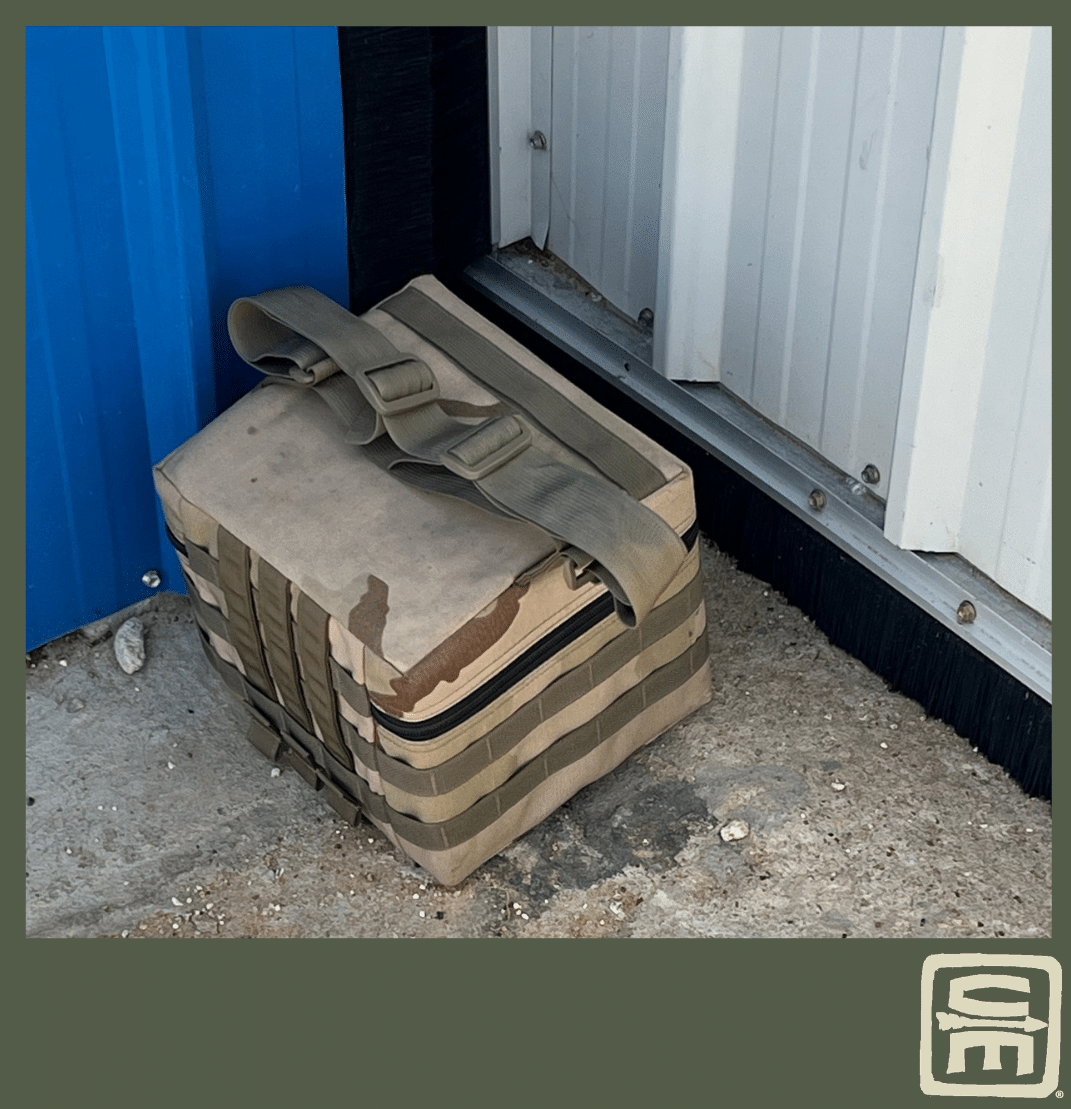
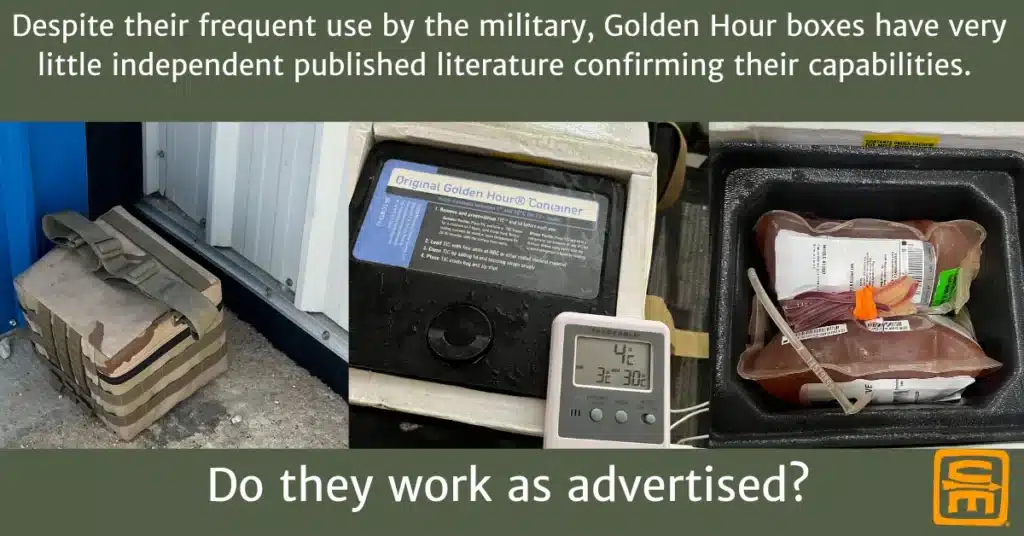
Despite their frequent use by the military, “golden hour boxes“ have little independent published literature confirming their capabilities.
🕖 Reading Time, 4 minutes
Researched and written by Mike Shertz, MD/18D, not AI
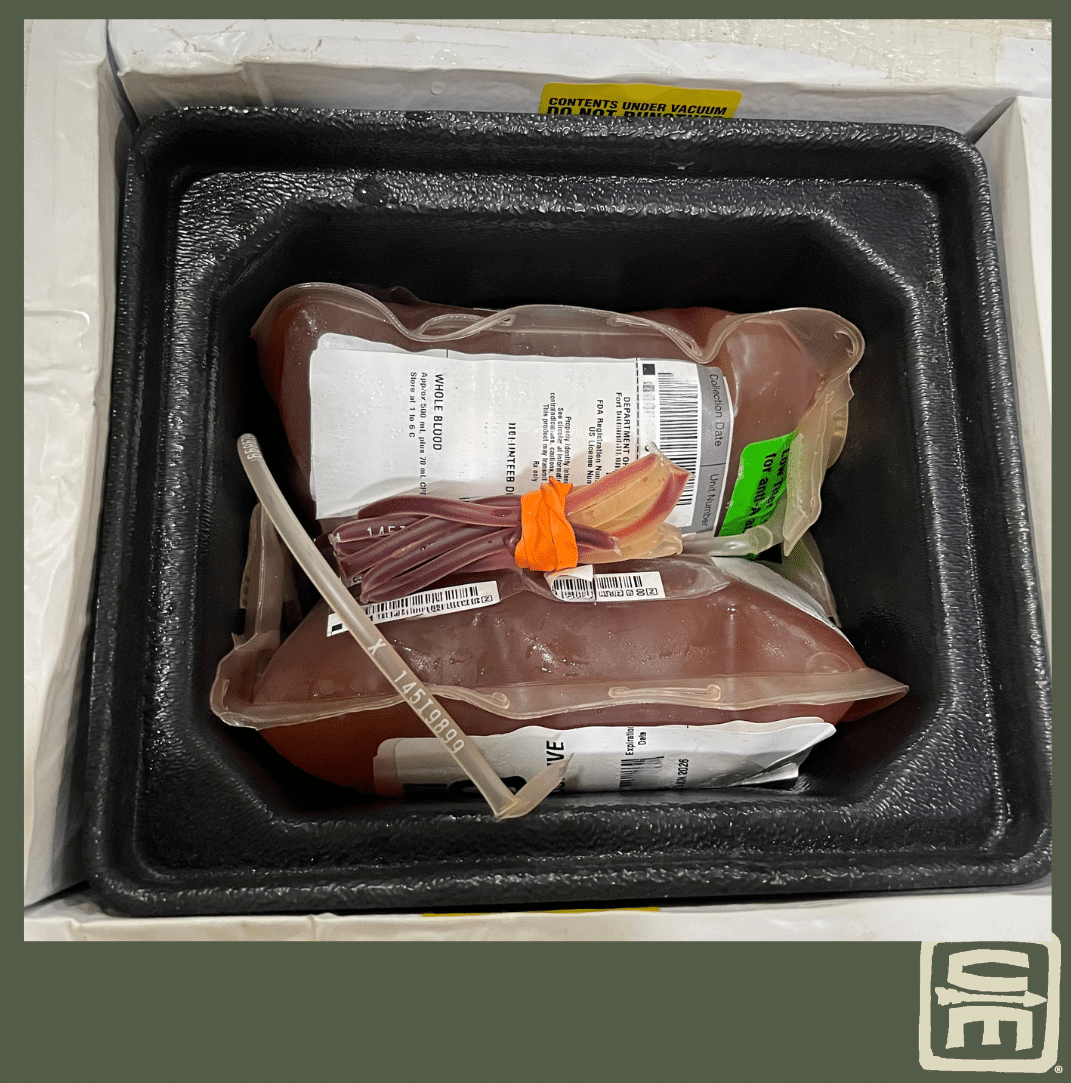
These easily portable boxes will generally maintain two units of whole blood, or four units of components, at safe cold temperatures for many hours without power or batteries.
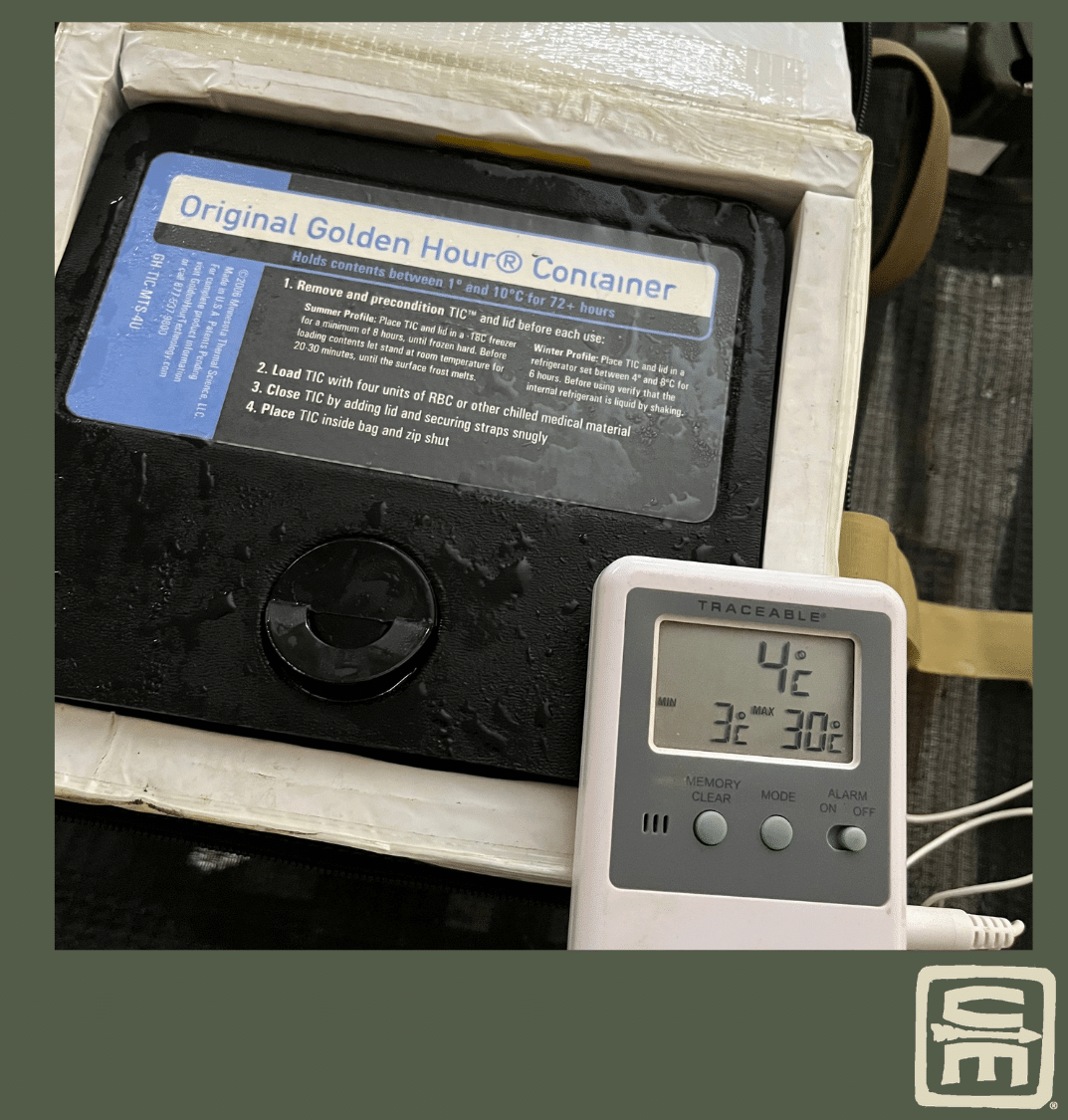
Golden hour boxes consist of a thermal insert with “phase change material” that is preconditioned by eight hours of freezing (manufacturer recommended) which is then placed in an insulated box of “vacuum insulated panels”and carrying case. Refrigerated blood is then placed inside last.
Manufacturers state the boxes will keep blood the desired 2 to 6°C safe temperature for 24 to 72 hours. That’s a big range.
How are you supposed to know when 24 hours is your maximum versus 72?
What the Studies Show
A 2004 study using a golden hour box similar to the current standard showed the box would maintain blood temperatures between 1 and 10°C:
- 96 hours if the environmental temperature was -24 °C
- 78 hours if the environment was 40°C
- 121 hours at 23°C
If you tighten the blood temperature ceiling to 6°C instead of 10°C, safe storage time dropped to:
- 68 hours at 40°C
- 107 hours at room temperature (23°C)3
A 2022 study of golden hour boxes in the USCENTCOM area of responsibility showed with 8 hours of pre freezing of the box insert, 2 units of whole would maintain proper temperature of 1 to 6 °C for only 36 hours. Though, the average ambient temperature the box was exposed to was 34.8 °C., the highest environmental temperature was 45 °C or 113° Fahrenheit.1
What about using the boxes in cold environments?
A 2024 study showed 100 hours of satisfactory blood temperatures at -5°C, 52 hours at -15°C, and 29 hours at -25°C.2
It has also been found that opening the container once during the testing interval would result in a loss of 2 to 3 hours of storage time compared to the same container and environmental temperature if it was left unopened.3
In my experience with environmental temperatures between 22 and 32°C, two units of refrigerated whole blood maintained a temperature of 3 to 4°C for 48 hours, but by 75 hours had warmed to 12°C. The golden hour box used was opened once a day to check internal temperature, which may have cost it 4 to 6 hours of safe cooling time.
Only the USCENTCOM study and my experience were in actual climates. The other studies were all conduced in lab settings with steady heat or cold. As seen in the USCENTCOM data, wide temperature swings will affect box performance.
What This Means Operationally
Take home message: golden hour boxes do work as designed.
Nonnegotiable: You must prefreeeze the insert, which takes 8 hours. If you want to be constantly operationally ready, the insert will need to be stored in the freezer so it is ready for immediate use.
How long your blood stays at a safe temperature depends on ambient conditions:
- Extreme cold (below -25°C) or extreme heat (above 34.8°C, with spikes to 45°C): expect 29–36 hours of safe storage
- Consistently warm (32–40°C, without extremes): 68–72 hours is reasonable if the box stays sealed
- Near room temperature: potentially beyond 72 hours if necessary
When in doubt about the actual temperature of your blood, err on the safe side and don’t push it. A conservative rule: subtract 12 hours from the expected duration for your ambient temperature range.
References
1Avila CO, Sayson SC, Bennett B. Whole Blood Storage Temperature Investigation in Austere Environments. J Spec Oper Med. 2022 Sep 19;22(3):19-21.
2Vuong A, Derkenne C, Travers S, Javaudin O, Clavier B, Martinaud C, Pasquier P. Performance of far forward iceless blood storage containers in controlled cold environments. Transfusion. 2024 May;64 Suppl 2:S50-S57.
3Rentas FJ, Macdonald VW, Houchens DM, Hmel PJ, Reid TJ. New insulation technology provides next-generation containers for “iceless” and lightweight transport of RBCs at 1 to 10 degrees C in extreme temperatures for over 78 hours. Transfusion. 2004 Feb;44(2):210-6.