Chemical Decon for Operational K9s: What Handlers Miss

A heading slide showing a reference from an article by France et al showing Decon areas on a K9 and fur samples

Fur Slows Chemical Agents, But Not Everywhere Equally

🕖 Reading Time, 5 minutes

Researched and written by Mike Shertz, MD/18D, not AI

Operational K9s are initially protected from dermal chemical and toxic exposures by their fur. However, the length and density of the fur coat protection provides widely variable protection across body regions.

Although the current US military standard for decontamination of chemical warfare agent (CWA) exposed humans is Reactive Skin Decontamination Lotion (RSDL), there is no published literature on its use in an operational K9.

Perry EB, Discepolo DR, Jenkins EK, Kelsey K, Liang SY. An assessment of working canine contamination from standing liquid hazards during a simulated disaster search scenario. J Vet Behav. 2021 May-Jun;43:1-6.

Protect Yourself First. The Data Says the Dog Can Wait.

Because the fur coat slows absorption of CWA in exposed canines, handlers should decontaminate themselves and don PPE, if not already worn, before attempting decontamination of a canine.

In the study described below, both VX nerve agent and sulfur mustard (HD), a vesicant, showed little absorption through canine fur for a full 60 minutes. That supports the “protect yourself first” model without meaningfully compromising the canine.

When the Only Study Available Is a Manufacturer Study

Generally, as a physician, I do not believe the results of any manufacturer-sponsored study (they have a very vested interest in showing their product works). Sometimes, you have to make an exception when there is no other literature to look at.

Laboratory Testing on Cadaver Fur, VX, and Sulfur Mustard

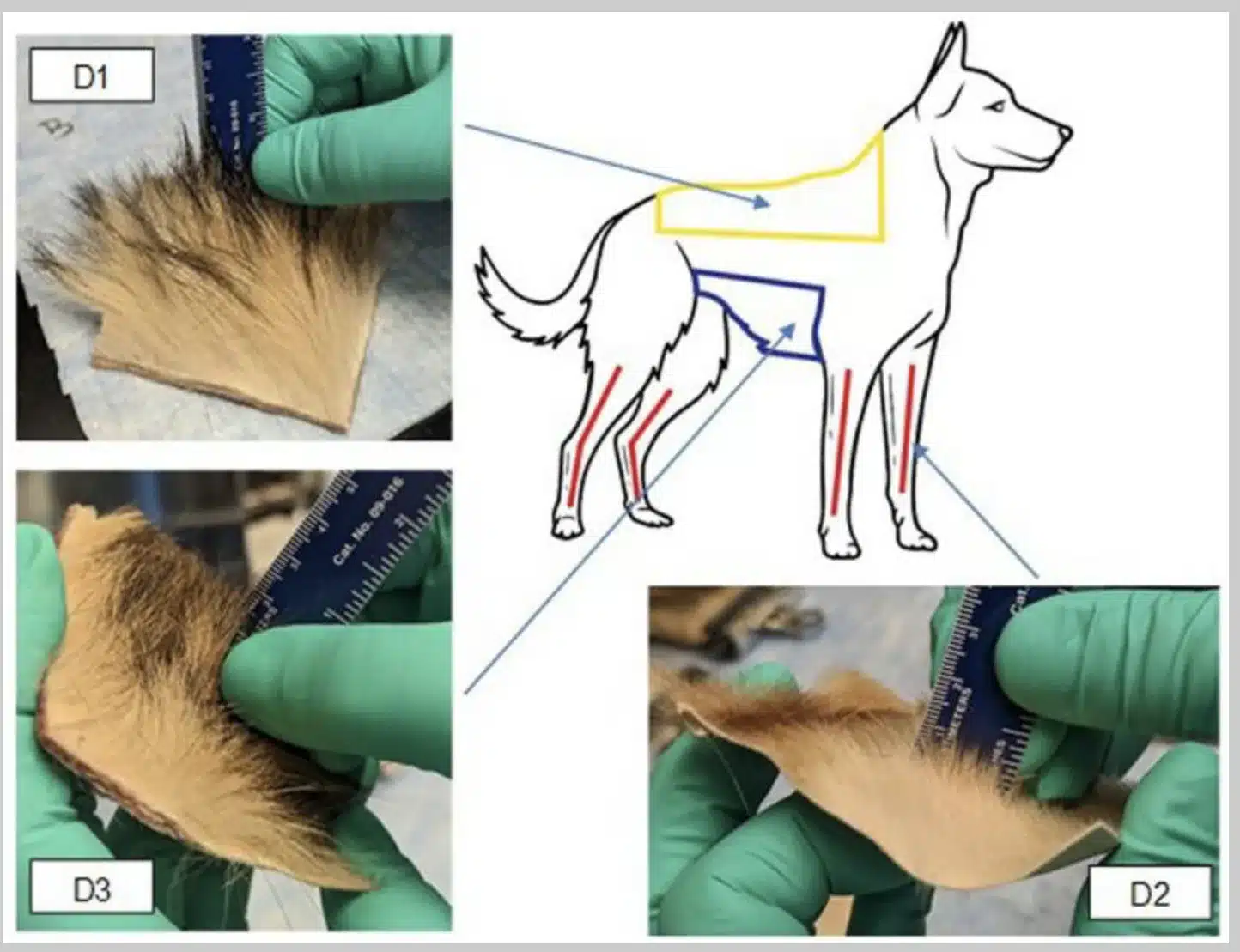
In the following study, authored by the apparent patent holder of a “Canine Field Decontamination Kit,” 1-inch square skin and fur samples, taken from various locations on the body of a cadaver Belgian Malinois and German Shepherd mixed dog, were contaminated with either 99% pure VX nerve agent or 92% sulfur mustard, a vesicating CWA. Liquid CWAs were allowed to dry on the samples for 30 minutes. The authors used three skin and fur samples from three different body regions.1

The samples were then decontaminated either by the proprietary kit or by soap and water using Dawn Ultra dishwashing liquid.

The Kit Is Dry, Wet, Dry, With No Neutralizing Agent

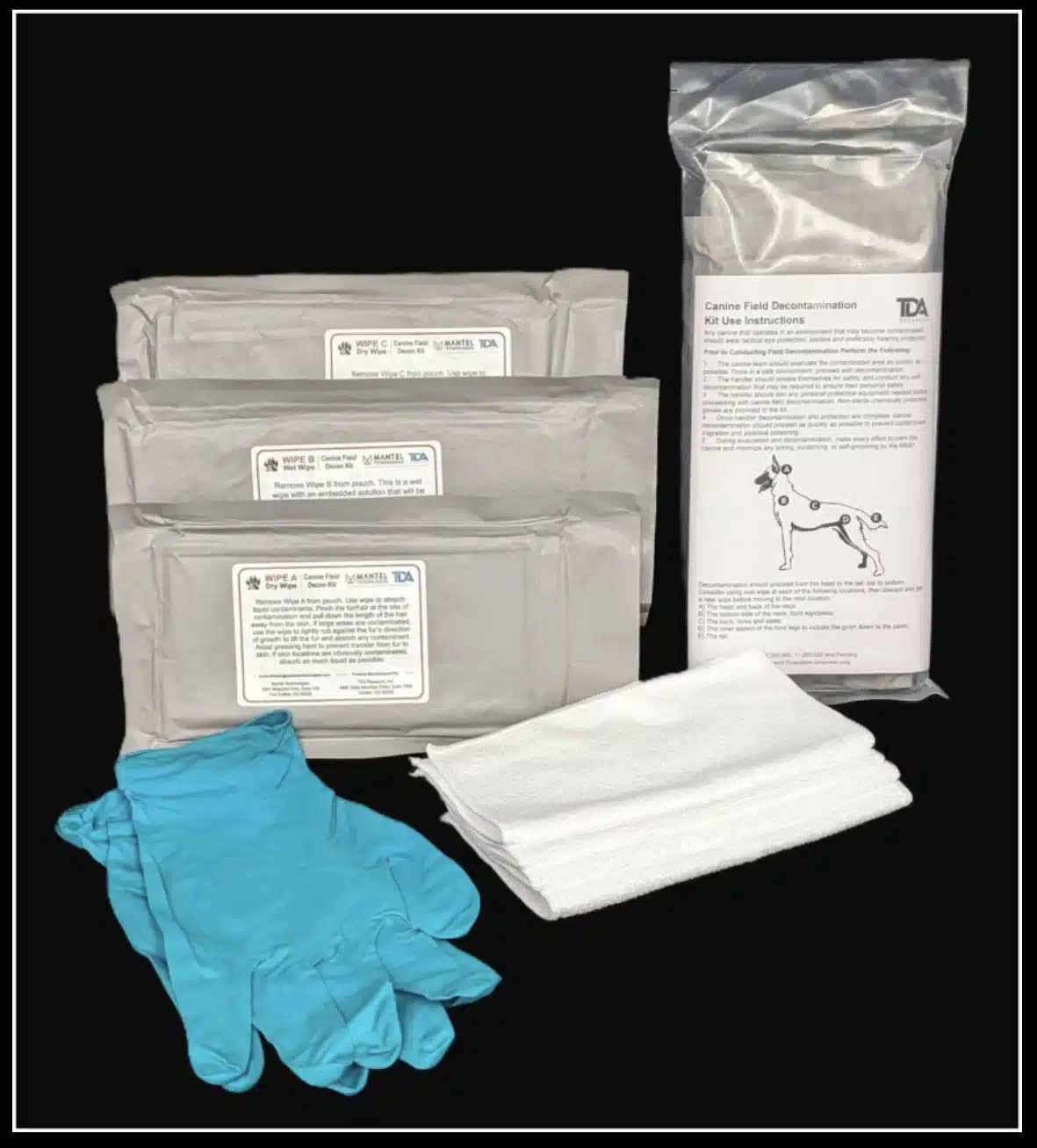
The proprietary kit consisted of dry microfiber wipes, followed by “wet” surfactant wipes, and finally dry microfiber wipes again. The wipes did not contain any neutralizing substances. Their function was only to remove contamination. Each “dry, wet, dry” decontamination sequence took 6 minutes and used a “pinch and pull” method.1

An image showing a K9 CBRN Decon kit, with wipes, gloves, and instructions
Buntz RG, Haselden MK, Badola KP, Sharp JL, Mann KA, France B. An evaluation of a canine dry wipe decontamination kit. Front Vet Sci. 2026 Feb 12;13:1770205.

Soap and Water Meant Dawn Ultra, a Toothbrush, and 30 Seconds

This dry/wet/dry method was compared with Dawn Ultra dishwashing liquid and water, mixed at a previously studied and optimized ratio. Each sample was rinsed with water, lathered with soap, worked into the fur with a toothbrush for 30 seconds, rinsed with water, and “tapped” to remove excess water. The authors said this would simulate a canine “shaking” after getting wet. Samples were then allowed to dry for 30 minutes before analysis.1

Both Methods Cut Absorption, But Soap Lagged on Mustard

The Canine Field Decontamination Kit decreased skin absorption of VX and sulfur mustard by 98% and 99%, respectively. Soap and water decreased skin absorption of VX and sulfur mustard by 96% and 85%, respectively.1

Forelegs Showed only 70% reduction, and the Wash-In Effect Reappeared

There were two interesting observations about soap and water decontamination. First, skin and fur samples from the forelegs showed only a 70% reduction in skin absorption of sulfur mustard. Other body-region samples, and all those washed after VX exposure, were consistently reduced to the 90th percentile range. Second, there is a known “wash-in” effect, where soap and water actually enhance the ability of an oily CWA such as VX to penetrate into the skin. That was once again seen in this study.1

A reference from an article by France et al showing Decon areas on a K9 and fur samples
France B, Malloy TA 4th, Buntz RG, Mann KA. Canine decontamination, a laboratory study evaluating proper techniques to remove toxic materials from working dogs. Front Vet Sci. 2025 Sep 26;12:1649673.

Field Testing With a UV Tracer on 64 Working Dogs

In a follow-up study, the same manufacturer of the “dry, wet, dry” operational K9 decontamination wipe system studied a convenience sample of canine handlers and their performance using several different-sized wipes to remove a simulated chemical contaminant from their canines.2 A liquid substance, visible only under UV light, was applied to the back, inguinal area, and forelegs of 64 operational K9s. Resesarchers directed handlers to decontaminate their canines with the provided wipes.2

The Back Decontaminated Best. The Inguinal Area Decontaminated Worst.

Handlers were able to remove 75-100% of contamination using the “dry, wet, dry” system. The best decontaminated areas were the backs, likely both because the guard hairs are longer there, facilitating agent removal, and because the back is easier to reach. The forelimbs and inguinal areas showed the least decontamination. On the forelimbs, 82% of the substance was removed. Worst of all, inguinal areas showed a reduction of agent of only 70%. The study authors observed the handlers decontaminating their canines and noted that the inguinal area was the most difficult to reach.2
  • One in nine handlers skipped an entire body region.
  • Total average time for canine decontamination using the “dry, wet, dry” wipes was 9.5 minutes.
  • Some handlers spent only 3 minutes, while others spent up to 26.2

FEMA Search Dogs Came Back Contaminated on the Undercarriage

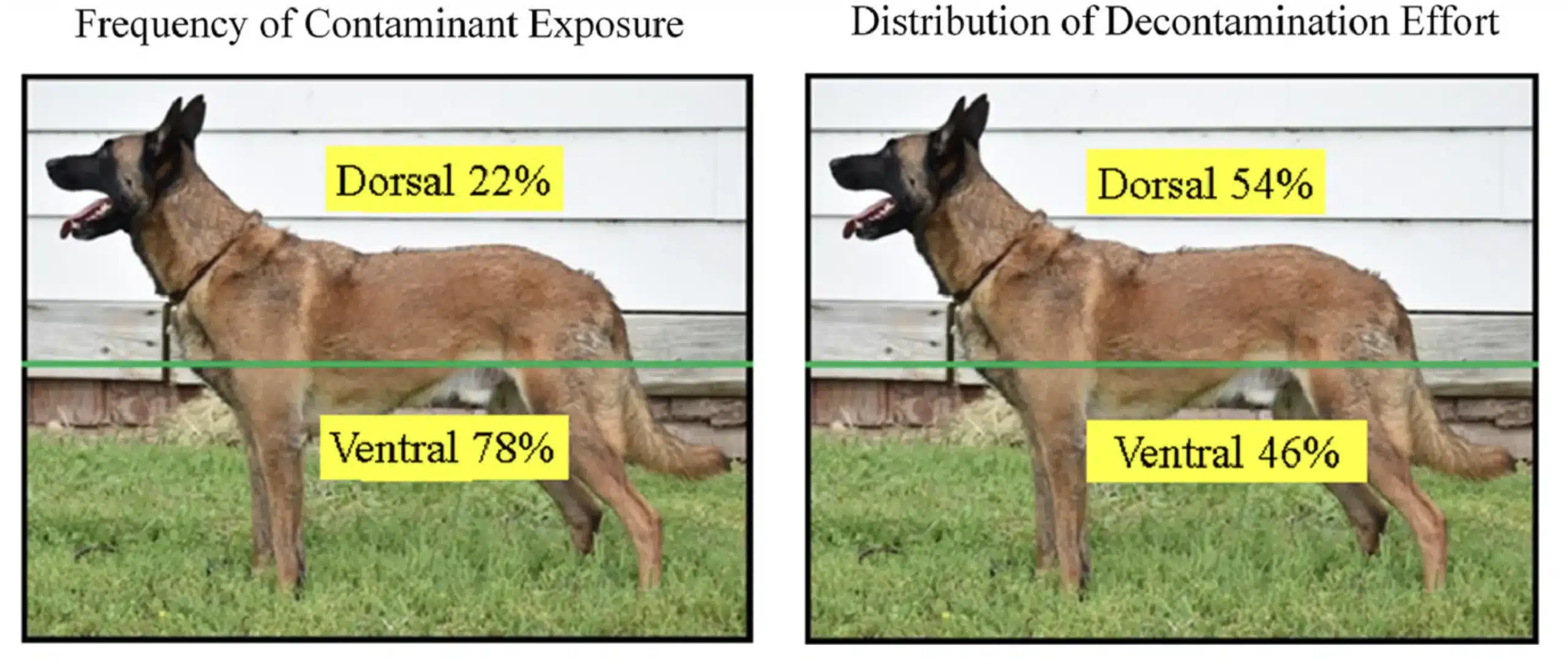
In a completely unrelated study, 11 FEMA operational K9s searched a disaster training site contaminated with one of three different “oily” liquid and standing liquid contaminants. This resulted in 44 contaminated operational K9s. Seventy-eight percent of the contamination was on the ventral side of the dog.

Bathing a Dog Is Not the Same as Decontaminating One

Handlers were then asked to decontaminate the canines. Handlers spent essentially as much time deconning the top half of the dog as the bottom half, despite the bottom half carrying the most contamination. Bathing the dog is not the same as decontaminating them. Exposure to an aerosol or vapor could yield different results.3

What This Means for You and Your K9

Operational K9s searching a chemically contaminated environment will disproportionately have agent on their undercarriages and limbs. Handlers, even knowing they are decontaminating exposed K9s, still skip areas. VX and HD, both oily liquid agents, can remain on fur without penetrating the skin for an hour, provided the skin and fur do not move. What operational K9 was ever motionless for an hour? Dry, wet, dry decontamination methods work well on K9s and people, while avoiding the “wash in” effects of soap and water.

Take Home Message:

  • Decontaminate yourself and don PPE before you decontaminate the dog. The fur coat buys the K9 time that humans do not have.
  • Contamination concentrates on the undercarriage, inguinal area, and limbs. Those are the same areas handlers reach last and clean worst.
  • Dry, wet, dry wipe systems removed 98% of VX and 99% of sulfur mustard in the laboratory, and avoided the soap-and-water “wash in” effect.
  • Soap and water underperformed against sulfur mustard, dropping to a 70% reduction on foreleg samples.
  • Eleven percent of handlers skipped an entire body region. Train a fixed decontamination sequence so that no area depends on memory under stress.

Interested in learning more?

Online courses. Medically researched, tactically relevant. Asynchronous training, train when and where you are.

References

There Is No Published RSDL Data for Operational K9s

1 France B, Malloy TA 4th, Buntz RG, Mann KA. Canine decontamination, a laboratory study evaluating proper techniques to remove toxic materials from working dogs. Front Vet Sci. 2025 Sep 26;12:1649673.

2 Buntz RG, Haselden MK, Badola KP, Sharp JL, Mann KA, France B. An evaluation of a canine dry wipe decontamination kit. Front Vet Sci. 2026 Feb 12;13:1770205.

3 Perry EB, Discepolo DR, Jenkins EK, Kelsey K, Liang SY. An assessment of working canine contamination from standing liquid hazards during a simulated disaster search scenario. J Vet Behav. 2021 May-Jun;43:1-6.

Picture of Mike Shertz MD/18D

Mike Shertz MD/18D

Dr. Mike Shertz is the Owner and Lead Instructor at Crisis Medicine. Dr. Shertz is a dual-boarded Emergency Medicine and EMS physician, having spent over 30 years gaining the experience and insight to create and provide his comprehensive, science-informed, training to better prepare everyday citizens, law enforcement, EMS, and the military to manage casualties and wounded in high-risk environments. Drawing on his prior experience as an Army Special Forces medic (18D), two decades as an armed, embedded tactical medic on a regional SWAT team, and as a Fire Service and EMS medical director. Using a combination of current and historical events, Dr. Shertz’s lectures include relevant, illustrative photos, as well as hands-on demonstrations to demystify the how, why, when to use each emergency medical procedure you need to become a Force Multiplier for Good.