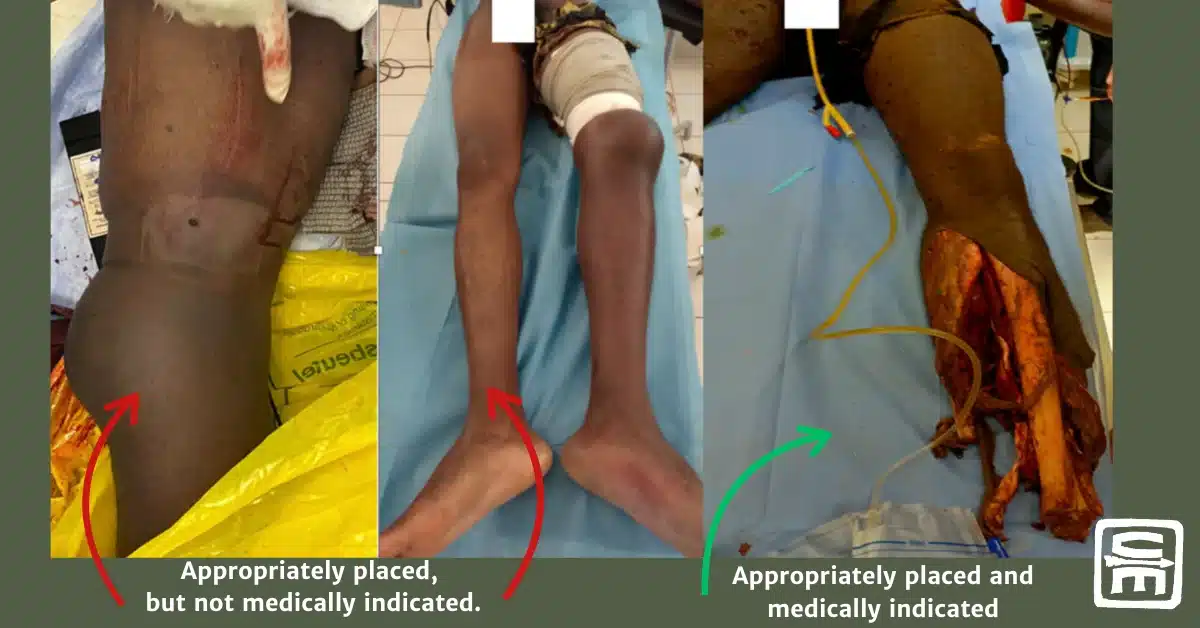
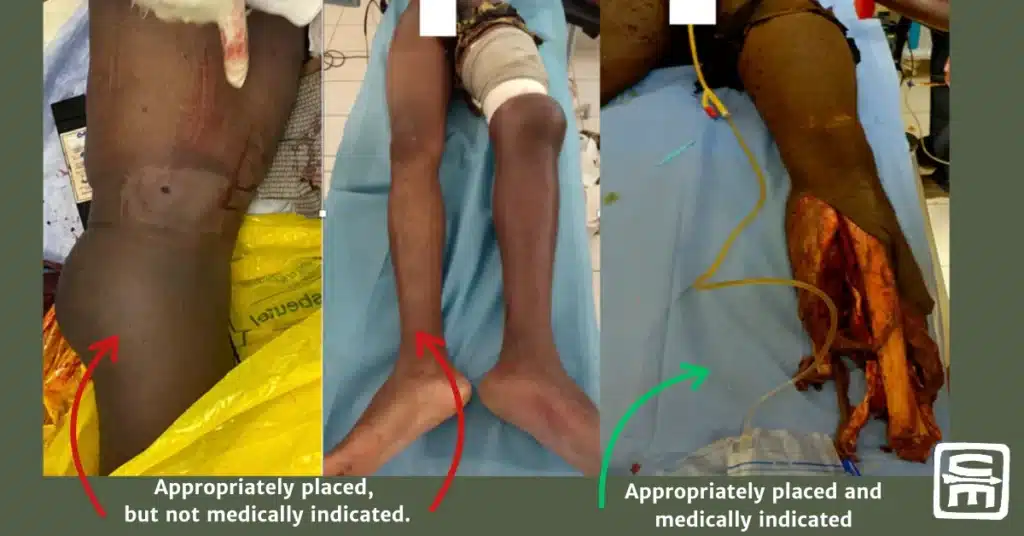
Only 5.3% of tourniquets placed by national military forces in Burkina Faso were both medically necessary and appropriately placed.
50% of all their amputations were a byproduct of unnecessary tourniquets.
Researched and written by Mike Shertz, MD/18D, not AI
🕖 Reading Time, 2 minutes
Though much is known about tourniquet applications during the Global War on Terror and increasingly from Ukraine, very little is published about the tourniquet experience in low resource conflict zones. Until know.
A single center, prospective observational study of 100 national military casualties in the Sahel (Burkina Faso), receiving tourniquet application over a six-month period in 2025 was conducted. All were seen at the largest military hospital in the country.
As exact tourniquet duration wasn’t always known, total prehospital time was used as a surrogate marker.
Tourniquets were defined as medically indicated if there was “traumatic amputation, mangled unsalvageable extremity with concern for arterial hemorrhage, arterial hemorrhage not amenable to control with compression or wound packing, or based on clinical assessment of receiving senior surgeon”.
Tourniquets were defined as appropriately applied if they were placed “several finger breaths above the level of injury or immediately above a joint. They also had to be applied tightly enough to include arterial flow.” If an improvised tourniquet was placed, it had to be made of an “appropriate material.”
Seventy five percent of tourniquets placed were by the military who were issued CAT tourniquets. Mechanism of injury was gunshot wound in 64% followed by IED drone injuries and 36%. 72% of casualties had lower extremity injuries. This is consistent with GWOT tourniquet location as well.
Though prehospital time was available for only 91% of patients, the mean prehospital time was 11.9 hours. Only 2 were seen in less than one hour after injury, 14 between 1 and 3 hours, 18 within t3 to 6 hours, and all the remainder seen between 6 and more 24 hours after injury.
What did they find? Only 5.3% of their tourniquets were felt to be both medically necessary and appropriately placed. 32.5% were not medically necessary but appropriately placed. 19.3% medically necessary but not appropriately placed, and finally 43% neither indicated, nor appropriately placed.
93% of lower extremity tourniquets were placed on the thigh, despite 33.3% of injuries occurring above the knee. In some cases, the leg injury was close to the knee joint, but in most tourniquet, placement was “high and tight.”
24 casualties underwent an amputation. 50% of them were felt to be a direct byproduct of tourniquet placement that was not medically necessary.
What does this tell us? High and tight tourniquet application makes sense in a care under fire or direct threat environment where there is no time to identify the exact location of every wound on a limb, because you are basically being shot at.
However, in tactical field care / indirect threat and certainly casualty evacuation, all tourniquets need re-evaluated for true need, converted or relocated closer to the wound. If you don’t do that your tourniquet placement absolutely could be responsible for the casualty undergoing amputation, as was the case in half of all amputations in this study. Once again, don’t be that guy. Do the right thing for you casualty and your buddy.
References + photo attribution
Nacanabo YAR, Traoré AF, Sanou SYG, Dakissé Nikiema S, Bassinga JY, Konate SM, Bagayogo Y, Holcomb JB, Wild HB. Prehospital tourniquet use and associated outcomes in a low-resource conflict setting: prospective observational casualty data and tourniquet classification system from the Sahel. BMJ Mil Health. 2026 Jun 24:military-2026-003332. doi: 10.1136/military-2026-003332. Epub ahead of print. PMID: 42349916.