
Researched and written by Mike Shertz, MD/18D, not AI
🕖 Reading Time, 4 minutes
Multiple methods of ABO blood typing are approved by the US FDA. Nearly all of them require specialized instruments and chemical reagents, and those items are rarely, if ever, available in a truly austere setting.
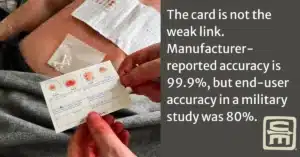
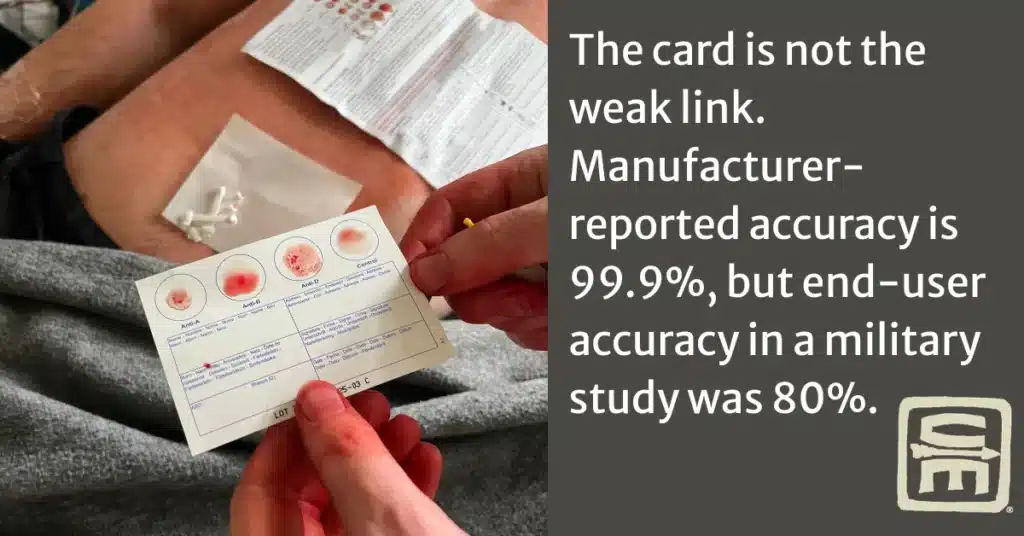
The Eldon card is a dry reagent, field friendly ABO Rh blood typing kit. The manufacturer reports 99.9% accuracy compared to more traditional ABO Rh blood typing techniques. That figure describes the card. It does not describe the person holding it.
The obvious follow-up question: how accurate is the Eldon card after it has been sitting in a deployed location for months with no environmental protection?
A military research study examined the Eldon blood typing kit’s accuracy across a range of operational temperature and humidity levels, and its stability in long-term storage from -30C to 50C for one to nine months.2
Accuracy was tested by typing previously identified known blood type samples with Eldon cards inside an environmental chamber: high temperature with low humidity at 41C, high temperature with high humidity at 33C, and low temperature at 6C with both high and low humidity. Those conditions correlated with weather in Kuwait and Okinawa. Researchers tested each condition, environment, and duration on hundreds of Eldon cards.
Eldon cards performed equally whether the blood typing occurred at room temperature or under the environmental conditions above. Accuracy determining O POS was 100% and O NEG was 99%.2
JTS Clinical Practice Guideline ID:82 (dated 30 Oct 2020) addresses prehospital blood transfusion. In its ranking of desirable blood products, fresh group O whole blood of unknown titer drawn from a walking blood bank and typed by Eldon card or equivalent sits at the bottom of the list. Given the Eldon card’s documented field accuracy, that placement is reasonable.3
The Eldon card is an environmentally stable field method for determining ABO Rh blood type, with high but nowhere near perfect degree of accuracy.
Given the potential severity of a hemolytic transfusion reaction, the Eldon card is best used to verify blood types rather than to determine them de novo. If you are going to use it to identify previously untyped blood donors, you will need to follow the old skydiving adage: everything will be fine, just do not screw up a single thing.
Reading the directions and comparing your results against the interpretation card will help.
1 Bienek DR, Perez NM. Diagnostic accuracy of a point-of-care blood typing kit conducted by potential end users. Mil Med. 2013 May;178(5):588-92. doi:10.7205/MILMED-D-12-00500. PMID: 23756020.
2 Bienek DR, Charlton DG. Accuracy of user-friendly blood typing kits tested under simulated military field conditions. Mil Med. 2011 Apr;176(4):454-60. PMID: 21539170.
3 Voller J, Tobin JM, Cap AP, et al. Joint Trauma System Clinical Practice Guideline (JTS CPG): Prehospital Blood Transfusion, CPG ID:82. 30 October 2020. Reprinted in J Spec Oper Med. 2021;21(4):11-21. PMID: 34969121.