
Researched and written by Mike Shertz, MD/18D, not AI
🕖 Reading Time, 6 minutes
Treatment of symptomatic, envenomated snake bite patients principally involves the parenteral administration of offending snake specific antivenom to prevent or reverse harmful and life-threatening effects from the bite.
Unfortunately, this same treatment frequently causes allergic type (anaphylactoid) adverse reactions. These adverse reactions are common and can range from hives and itching to wheezing and hypotension.
The rates of adverse reactions have ranged from 3 to 88% in the published literature, likely secondary to “at least 46 manufacturers of animal derived antivenom worldwide” in 2022 alone. 1
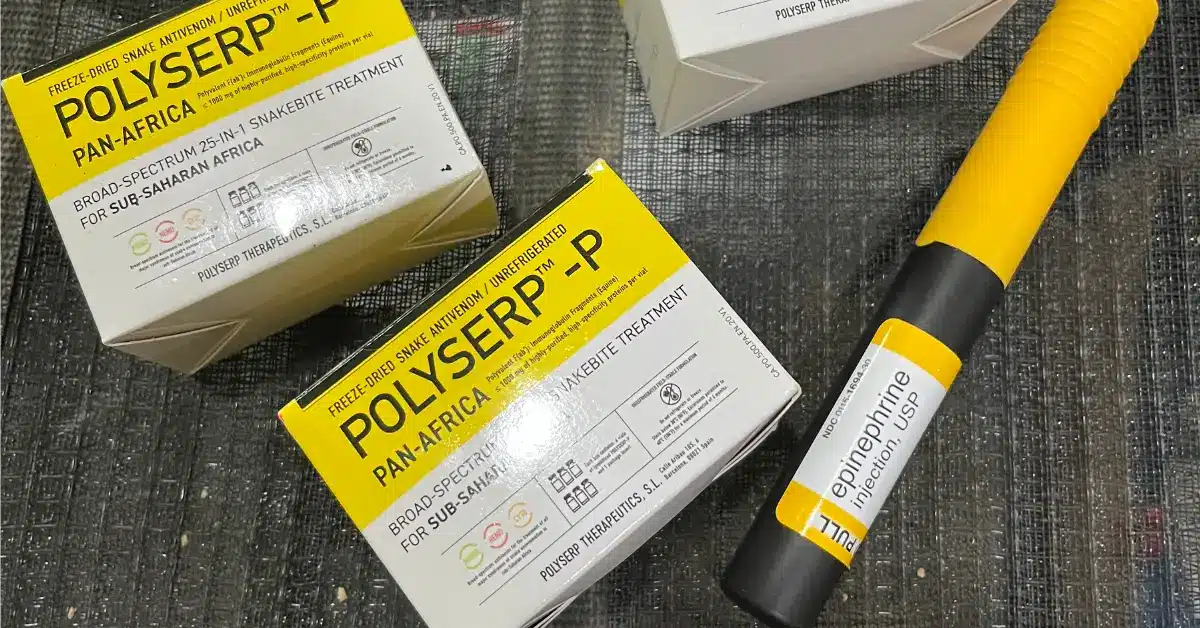
Antivenoms are made by collecting antibodies from hyperimmune horses, purifying them, and then bottling them for future use. Antivenoms can be monovalent, meaning only containing antibodies to one type of snake toxin, or polyvalent, containing a collection of antibodies to multiple types of snake venoms. If the biting snake is not clearly identified correctly, the wrong monovalent antivenom could be administered, hence the benefit of polyvalent.
There is some debate about how fast snake anti-venom should be administered. There has traditionally been a sense that if administered slower, over 30 to 60 minutes, rather than a short bolus over minutes, there would be fewer adverse reactions.
In a Sri Lanka based controlled study, 198 snake bite casualties were randomized to two different antivenom infusion rates: 20 minutes versus 2 hours. The study showed no statistical difference in adverse events, 56% with the fast rate vs. 67% with the slow rate.3
POLYSERP, per the manufacturer, is administered over 3 minutes. The package insert states this is because it is high purity and has low additional proteins which might otherwise cause an allergic type reaction.2
The manufacturer claims severe adverse effects like anaphylaxis occur in 0.2% of POLYSERP PAN-AFRICAN recipients and 1% MENA recipients. All patients were described as responding to intramuscular epinephrine.2
Mild to moderate adverse reactions occurred in less than 8% of recipients. These included itching, hives, nausea, vomiting, cough, shivering, and “dizziness”.2
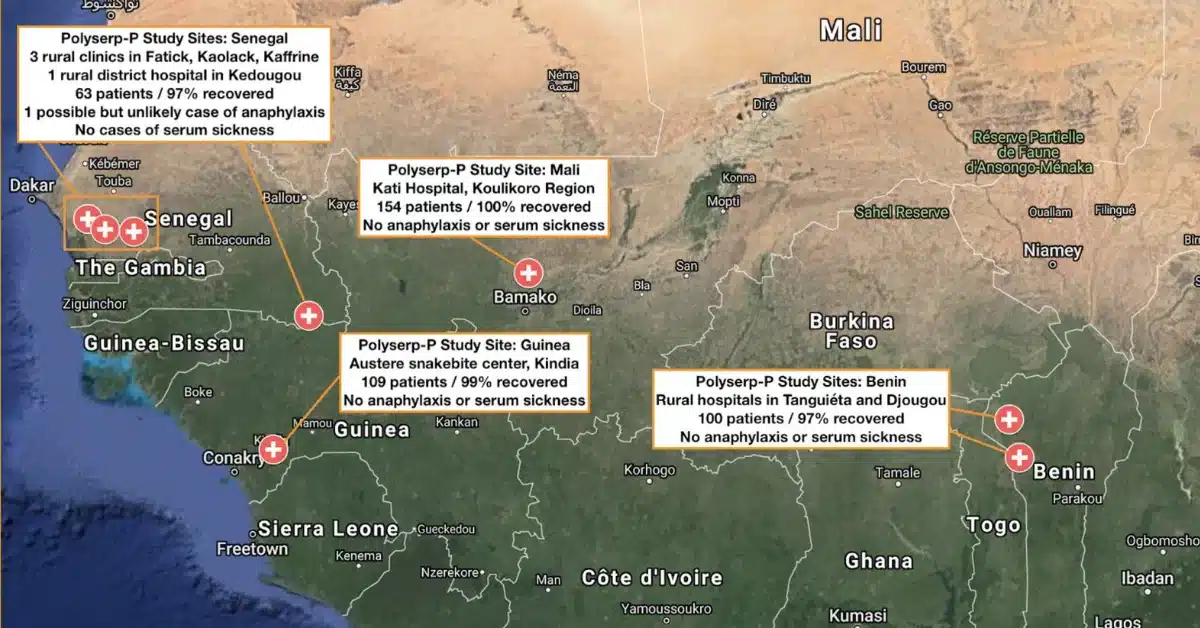
A previous version of POLYSERP, Inoserp, was studied across multiple countries in sub-Saharan Africa, specifically Benin, Cameroon, and Senegal. In those studies, it was administered as an IV bolus over 3 to 5 minutes.2
Per the manufacturer, of 426 snakebite patients treated, only 34 (7.9%) developed adverse side effects considered to possibly be secondary to the antivenom. Thirty-three were mild to moderate and not life threatening. One case of possible anaphylaxis did occur.2
Reactions ranged from only skin rash (68%) to bronchospasm (16%) and hypotension (15%).
In a similar study of the same antivenom used in Guinea to treat 96 snake bite victims, the adverse event rate was 5.5%. All appeared within the first ten minute of antivenom administration. None included anaphylaxis.2
In northwest Benin 100 snake bite victims were treated. There the adverse event rate was 11%. Ten cases were mild. Although the authors say there were no cases of anaphylaxis, one patient was hypotensive with a BP of 80/40 mmHg. The study authors did not think the hypotension was from the antivenom, but it’s impossible to say for certain.2
In a study published in 2024, using data collected in 2019 to 2021 in Cameron, also using Inoserp antivenom, 361 patients received antivenom. Angioedema occurred in one patient within 2 hours of administration. Bronchospasm occurred in another more than 2 hours post administration. In total, there were only 4 patients with adverse events. However, half of those required epinephrine administration. In this study antivenom was administered either IV bolus over 3 minutes or diluted over 30 minutes.4
Inoserp’s safety record still seems impressive compared to other antivenoms, which have shown adverse event rates of 20% or more.2
In a retrospective cross-sectional Thai study of 684 patients receiving antivenom for snake bite reported to their poison center, adverse drug events occurred in 22.5%. Seventy six percent of adverse drug events occurred within one hour after administration. The poison center’s recommend infusion time was over 30 to 60 minutes. The median time to reaction was 15 minutes after administration. The authors compared adverse drug reactions in those treated over 30 to 60 minutes (14%) versus less than 30 (38%) or longer than 60 minutes (26%). They determined their data supported administration over 30 to 60 minutes.1
The Sri Lanka randomized trial described earlier, however, showed no difference in severe reactions between administration over less than 20 minutes versus administration over 2 hours. They showed no difference in severe reactions.3
POLYSERP seems a very promising choice of snake antivenom with its temperature stability, polyvalent qualities, and reasonable adverse event rate compared to more traditional antivenoms. If adverse events do occur, they usually happen within 10 minutes of administration and generally are mild.
One technical issue though, the extensive Inoserp data above wasn’t technically POLYSERP, but rather a previous version. So one can correctly argue POLYSERP has no published literature yet to actually support it.
There is substantial controversy regarding his issue. If you would like to read more about this see:
The US Army spent close to $1B on untested snake bite drugs published by the Bureau of Investigative Journalism, and a response by Next Generation Combat Medic, Anti-venom research: A response to the venomous article by The Guardian and TBIJ
This post is not sponsored and is FYSA only.
Crisis Medicine does not accept payment from industry nor do we use affiliate links. We review and present the medical literature. You can read our Dislcosures-None statement.
1Sriapha C, Rittilert P, Vasaruchapong T, Srisuma S, Wananukul W, Trakulsrichai S. Early Adverse Reactions to Snake Antivenom: Poison Center Data Analysis. Toxins (Basel). 2022 Oct 9;14(10):694.
2POLYSERP+Next+Gen+Antivenoms.pdf . Last accessed on 17 AUG 26.
3Isbister GK, Shahmy S, Mohamed F, Abeysinghe C, Karunathilake H, Ariaratnam A. A Randomised Controlled Trial of Two Infusion Rates to Decrease Reactions to Antivenom. PLoS ONE. 2012;7:e38739.
4Benhammou D, Chippaux JP, Ntone R, Madec Y, Amta P, Noel G, Karl FN, Perilhou A, Matchim L, Sanchez M, Ndifon M, Clauteaux P, Eteki L, Boum Y 2nd, Nkwescheu AS, Taieb F. Snakebites in Cameroon: Tolerance of a Snake Antivenom (Inoserp PAN-AFRICA) in Africa in Real-Life Conditions. Toxins (Basel). 2024 Mar 22;16(4):165.