Train in a Car, Under a Chair: Why Position Matters in TECC/TCCC

Applying tourniquets in vehicles to delink your skills from your training site

Researched and written by Mike Shertz, MD/18D, not AI

🕖 Reading Time, 2 minutes

Where you learned a skill is stored along with the skill

When you learn a technique, there is more recorded in your brain than just how to do the task. Where you learned it and details about the source or instructor are also all there. You can use that to your advantage by studying for a test in the exact same room and seat you must take the test in. Your recall improves because details of the room and seat are also connected to the studied information. You can access that by “reinstating” yourself in that environment.

“Recall is better if the environment of the original learning is reinstated.”1 

If you can’t test in the exact same environment as you learned something, then you need to “learn” it in multiple settings. In this way, knowledge is not location-specific. 

The tactical situation picks your position, so train in all of them

In medicine, you always try to do your patient examinations from the right side, so each evaluation is reproducible and makes practice consistent.

In TECC/TCCC environments, the tactical situation drives all care. Therefore, you won’t be able to dictate which side you treat a casualty from because in a high-risk environment, you don’t get to choose. The position will be based on where the threats and danger areas are, as well as where and how your casualty is located.

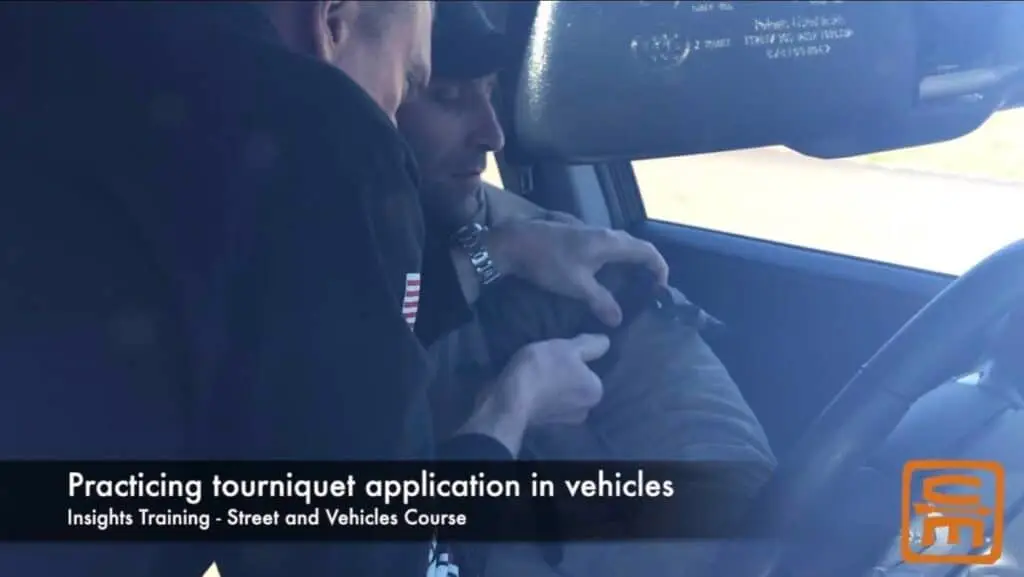
We use all of these concepts by practicing our high-risk casualty care techniques in multiple different settings. Sometimes you get to kneel by the casualty’s side and apply a tourniquet. Sometimes, you are above them on a chair reaching awkwardly down and around the chair, or on a table right on top of the casualty, and still other times you put tourniquets on everyone in a car from your seat.

All of this makes your technique independent and less about a specific classroom or patient orientation/position. That makes for solid performance.

It the corollary of a self-applied tourniquet is not the same thing as a buddy-applied one

References

1 Godden DR, Baddeley AD. Context Dependent Memory in Two Natural Environments: On Land and Underwater, British Journal of Psychology, 66: 325-331. https://doi.org/10.1111/j.2044-8295.1975.tb01468.x

Smith, S.M., Glenberg, A. & Bjork, R.A. Environmental context and human memory. Memory & Cognition6, 342–353 (1978). https://doi.org/10.3758/BF03197465

Related Articles

Picture of Mike Shertz MD/18D

Mike Shertz MD/18D

Dr. Mike Shertz is the Owner and Lead Instructor at Crisis Medicine. Dr. Shertz is a dual-boarded Emergency Medicine and EMS physician, having spent over 30 years gaining the experience and insight to create and provide his comprehensive, science-informed, training to better prepare everyday citizens, law enforcement, EMS, and the military to manage casualties and wounded in high-risk environments. Drawing on his prior experience as an Army Special Forces medic (18D), two decades as an armed, embedded tactical medic on a regional SWAT team, and as a Fire Service and EMS medical director. Using a combination of current and historical events, Dr. Shertz’s lectures include relevant, illustrative photos, as well as hands-on demonstrations to demystify the how, why, when to use each emergency medical procedure you need to become a Force Multiplier for Good.