🕖 Reading Time, 3 minutes
Researched and written by Mike Shertz, MD/18D, not AI
Salisbury, 2018: A Nerve Agent on a Front Door Handle
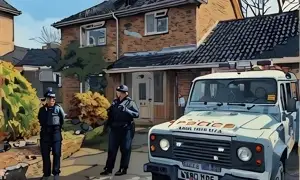
On March 4, 2018, in Salisbury, England, former Russian Military Intelligence officer Sergei Skripal and his daughter were found slumped on a public bench.1 After being evaluated at the hospital, it was determined that they were victims of nerve agent poisoning. A total of six victims were evaluated. Detective Sergeant Nick Bailey, who helped the Skripals, was also hospitalized.2 One individual died months later from a discarded container of the same agent.
Eventually, a chemical weapon was located on Skripal’s front door handle.2 The agent was a 4th generation or “A” series nerve agent, more commonly known as a Novichok agent, which means “newcomer” in Russian.
The Agents Came Out of a Classified Soviet Program Called FOLIANT
The “A” series or Novichok agents were the byproduct of a classified USSR/Russian program named FOLIANT, which ran from the 1970s to the 1990s.1 Much of what we know about the agents it created comes from Dr. Mirzayanov, an exiled Russian dissident who previously spent 26 years working for the State Scientific Research Institute for Organic Chemistry and Technology in Moscow.1
The FOLIANT agents were designed as binary weapons, mixed from two less regulated precursor chemicals at the point of use.” That is my sentence and not his, and it should not be published without his approval.
There are many advantages to binary agents. They are safer to handle, more stable, easier to dispose of, and the individual chemicals may not be specifically listed as prohibited substances in chemical weapons treaties providing deniability to their production.
A-230 and A-232 Are More Toxic Than VX and Soman
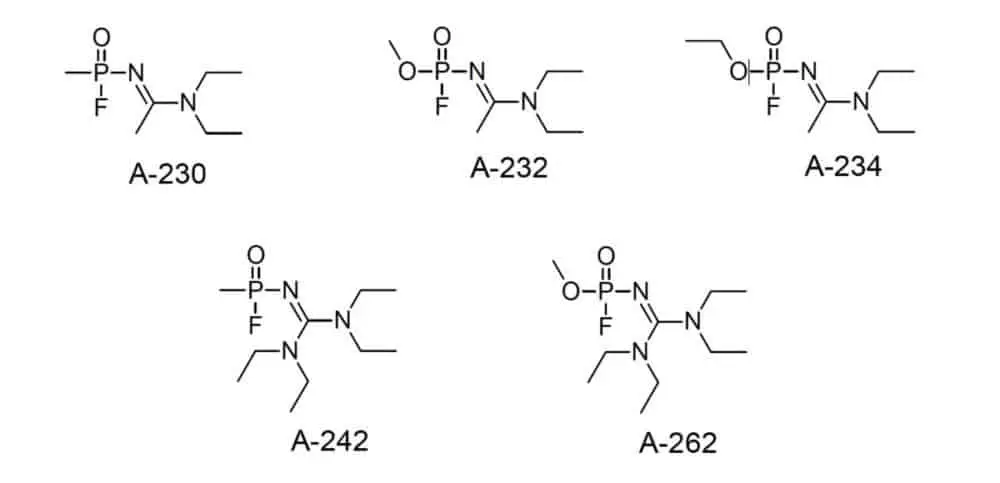
“A” series or Novichok agents use the more traditional “G series” (sarin, soman, etc.) nerve agents as a chemical backbone. Although over 100 were synthesized, few were weaponized. One, agent A-232, is felt to be ten times more toxic than Soman. Another, agent A-230, was found to be 5 to 8 times more toxic than VX, which was previously deemed to be the most toxic nerve agent. Most of these new agents are liquids, but two of the new agents are the first nerve agents that are solid at room temperature.3
The Salisbury Agent Persisted Across Nine Sites for Months
These agents do seem to be persistent, and the one used in Salisbury has been found in a total of nine sites, including three in the city center. Specialist decontamination lasted for months.2
Clinically, They Behave Like the Nerve Agents You Already Know
Clinically, these agents present similarly to more traditional nerve agents and organophosphates. Treatment, as best we can tell so far, also seems similar.
The Actual Chemical Structures Are Still Unconfirmed
The Soviet Union weaponized several of these agents, though they were never mass-produced. It is believed that several tons of “experimental quantities” were synthesized. Because of the secrecy surrounding the FOLIANT program, very little is known about the actual chemical structure of these agents. Although many have proposed various structures in scientific journals, it is difficult to confirm correct or possibly “fake structures,” which might be intentionally leaked by Russian counterintelligence services.3
Two Novichok Poisonings in Three Years, Both Unsuccessful
The frightening issue here is that a highly purified state-of-the-art novel nerve agent was used unsuccessfully in a targeted assassination in the UK just a few years ago. In 2020, Russian opposition activist Alexei Navalny was similarly unsuccessfully poisoned with a Novichok agent. Obviously, the threat posed by these kinds of agents is immense.
Interested in more information about CBRN?
Read about our comprehensive Tactical-CBRN course and learn both about the agents, as well as how to manage the casualty in front of you.
References
1Chai PR, Hayes BD, Erickson TB, Boyer EW. Novichok agents: a historical, current, and toxicological perspective. Toxicol Commun. 2018;2(1):45-48.
2Vale JA, Marrs TC OBE, Maynard RL CBE. Novichok: a murderous nerve agent attack in the UK. Clin Toxicol (Phila). 2018 Nov;56(11):1093-1097.
3Franca TCC, Kitagawa DAS, Cavalcante SFA, da Silva JAV, Nepovimova E, Kuca K. Novichoks: The Dangerous Fourth Generation of Chemical Weapons. Int J Mol Sci. 2019 March 11th;20(5):1222.