Ophthalmologic Mass Casualty!

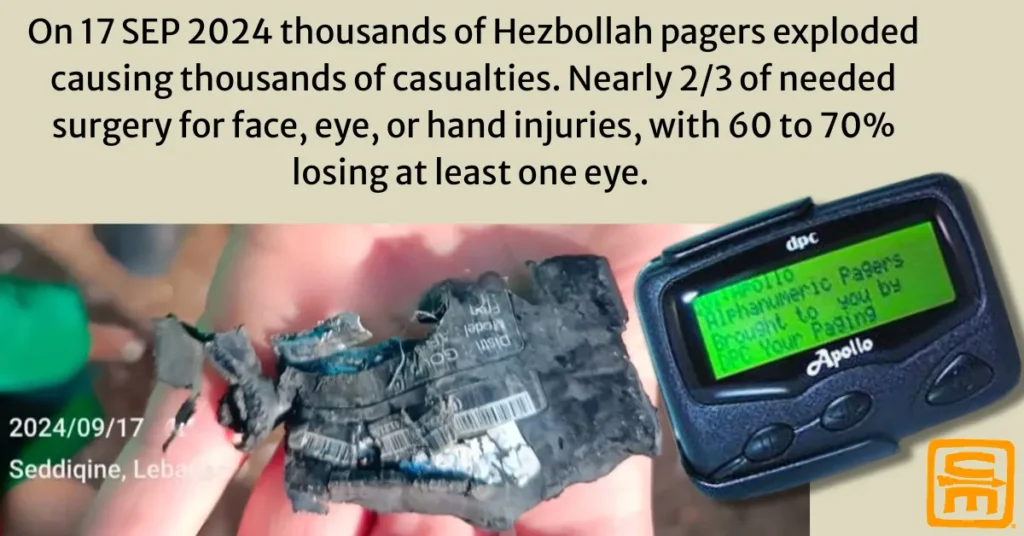
Two images, one showing a generic Apollo pager, the type used in the Hezbollah pager attack, and an exploded remnant of a pager

🕖 Reading Time, 2 minutes

On 17 September, 2024 at 1530, thousands of Gold Apollo AR-924 pagers, purchased by Hezbollah exploded over the span of an hour simultaneously causing an ophthalmologic mass casualty incident at multiple locations in Lebanon.

Hezbollah acknowledged 1,500 fighters sustained injuries. According to the Lebanese Ministry of Health, the attack killed 42 people, including 12 civilians, and injured at least 2,800.1

Others reported 4,000 were injured.

Seven months before the event, Hezbollah’s secretary general told group members to use pagers instead of cell phones because of concerns Israel infiltrated their phone network. Two months later Hezbollah purchased Gold Apollo AR-924 pagers. Unknown to Hezbollah, Mossad had placed 3 grams of PETN explosive into the pagers, which Hezbollah bought through a shell company.2

Nearly 2/3 of casualties needed surgery for face, eye, or hand injuries, with 60 -70% losing at least one eye. Amputations were also common. A large number required neuroimaging secondary to penetrating head injuries.1

Of 38 pager explosion injured casualties seen at the Lebanese American University Medical Center, 37 were “red tagged” or felt to need immediate care. Ultimately, 36 were admitted and 13 required ICU level care.1

Reports vary as to what the pagers did before detonating: Some casualties reported the pager making an unusual sound, prompting them to look directly at it. Others that the pager vibrated and displayed an error message triggering detonating when a button was pressed to clear the error. Some said an encrypted message appeared necessitating pushing 2 buttons simultaneously to read it, which caused both hands to be on the pager at time of detonation.1

Hospitals had difficulty providing timely ophthalmologic and orthopedic surgery for these casualties secondary to not enough surgeons with this specialty and limitations of how many ophthalmologic surgical sets each hospital actually had.1

References

1Helou M, Weinstein ES, Kalaji J, Chaaban T, Yammine K. Pager Explosion in Beirut: An Unprecedented Event. Disaster Med Public Health Prep. 2024 Oct 28;18:e215. doi: 10.1017/dmp.2024.281. PMID: 39463326.

2Wikipedia, 2024 Lebanon electronic Device attacks [https://en.wikipedia.org/wiki/2024_Lebanon_electronic_device_attacks#cite_note-:10-13] And yes, we cited Wikipedia, Wikipedia was studied and found to be more accurate than the Enclyopedia Britannica

Picture of Mike Shertz MD/18D

Mike Shertz MD/18D

Dr. Mike Shertz is the Owner and Lead Instructor at Crisis Medicine. Dr. Shertz is a dual-boarded Emergency Medicine and EMS physician, having spent over 30 years gaining the experience and insight to create and provide his comprehensive, science-informed, training to better prepare everyday citizens, law enforcement, EMS, and the military to manage casualties and wounded in high-risk environments. Drawing on his prior experience as an Army Special Forces medic (18D), two decades as an armed, embedded tactical medic on a regional SWAT team, and as a Fire Service and EMS medical director. Using a combination of current and historical events, Dr. Shertz’s lectures include relevant, illustrative photos, as well as hands-on demonstrations to demystify the how, why, when to use each emergency medical procedure you need to become a Force Multiplier for Good.