Researched and written by Mike Shertz, MD/18D, not AI
🕖 Reading Time, 5 minutes
Managing casualties in high-risk environments like active violent incidents, unstable buildings from explosion or earthquake, and houses on fire is inherently challenging. Adding the possibility of CBRN (chemical, biological, radiological, or nuclear) contamination to that management plan adds additional complexity.
While many fire departments have hazmat teams to deal with CBRN situations, the time pressures of managing traumatic injuries on a contaminated casualty may force medical management before specialized hazmat teams arrive.
The model comes from a 2018 Journal of Special Operations Medicine article
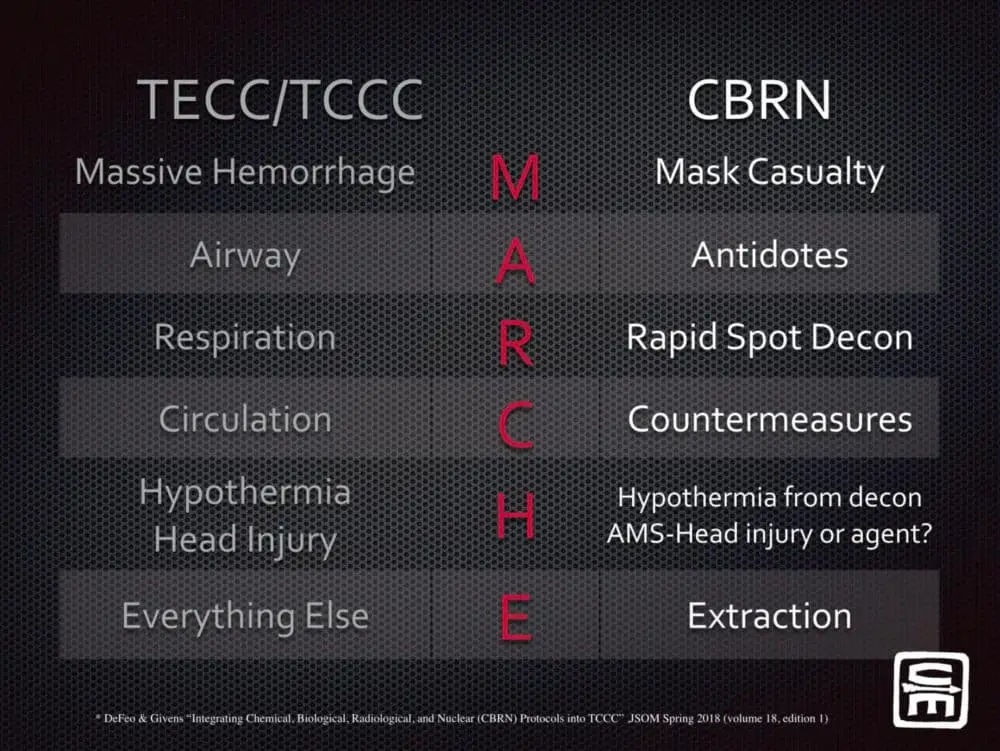
In this article, DeFeo and Givens outline how to combine TCCC and CBRN into what they call MARCHE2. The C-TECC Guidelines Committee published their own CBRN Guidelines in 2021.
Reusing MARCHE gives rescuers “cognitive unloading” in a CBRN event
The benefit of using the standard MARCHE mnemonic in high-risk environments is that each letter corresponds to a specific step in casualty management. Since casualties in a CBRN environment will likely also have traumatic injuries, using the same memory tool as an aid to CBRN patient treatment in these very complex situations can be useful and offer some “cognitive unloading” for the rescuers.
While we find it helpful anytime we are managing severely injured patients to ask the question “What is killing the casualty now,” DeFeo adds “Is it the agent or the wound?”1 These questions become even more critical in a CBRN situation. For example, a lethal VX nerve agent exposure can kill a casualty within minutes. A mustard agent exposure could be fatal in hours to days. A mustard agent exposed casualty with massive hemorrhage will succumb to their bleeding long before the toxic effects of the agent exposure.
MAR2 covers what can be done in the hot zone
Patients with CBRN exposure are likely initially treated or found in the hot zone / care under fire / direct threat phase of care. “Sometimes the agent is like the bullet, think care under fire.”2 Any medical intervention you would not perform while taking fire probably shouldn’t be done at the casualty’s point of contamination either. Casualty management here is largely to extract the wounded and medical providers in the safest way possible, while only performing immediately life-saving interventions.
MAR2 interventions include:
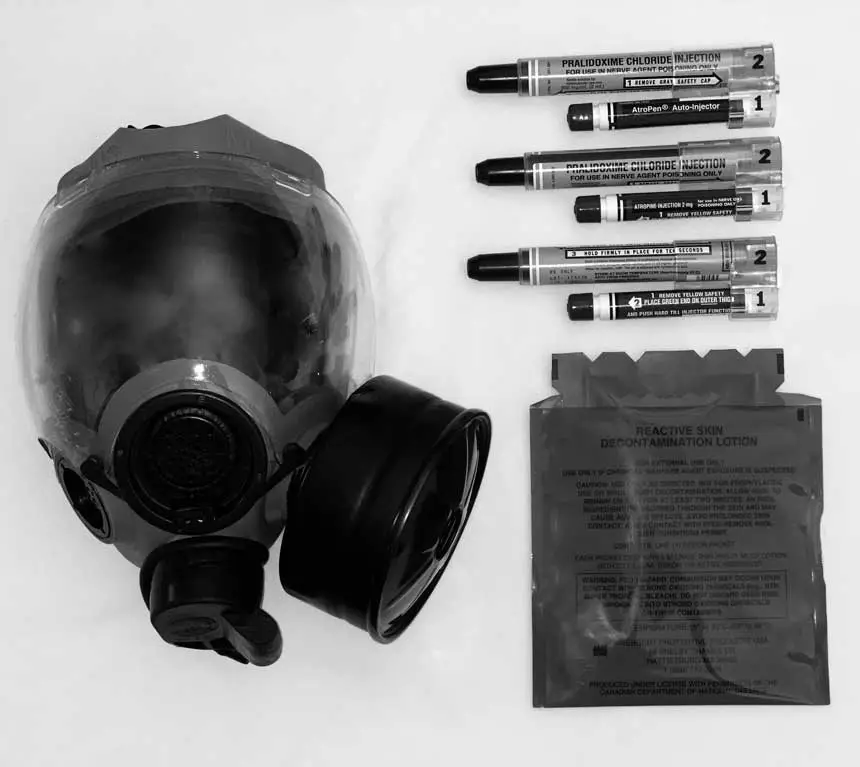
- “M” would involve helping the casualty “mask up” and ensure a proper seal of their protective mask. This would be akin to tourniquet placement for massive extremity hemorrhage.
- “A” is the administration of agent antidotes (Atropine / Pralidoxime nerve agent auto-injectors) if the casualty will succumb to the agent before decontamination can occur. More aggressive airway intervention in this phase would likely involve the removal of the casualty’s protective mask, which exposes them to more agent.
- “R” would involve “rapid spot decontamination” if the agent can be seen on the skin or through a PPE breach.
Regarding initial decontamination, DeFeo and Givens use the model of children who stepped in mud while playing outside as a reference to contaminated casualties. “We do not want them tracking mud in the house when they come home for dinner, but we do not want to leave them outside to go hungry.” 2 You don’t insist your kid completely disrobe and get naked before being allowed inside. You ‘rapid spot decontaminate’ the muddy areas and let them in.
Once active agent release stops, CHE2 becomes possible
Once extracted to the warm zone / tactical field care / indirect threat phases, while contamination is still possible, active agent release has ended. Here MAR2 interventions can be reassessed. In this phase, the “focus should be on medical interventions necessary to preserve life while simultaneously decontamination is being conducted.”
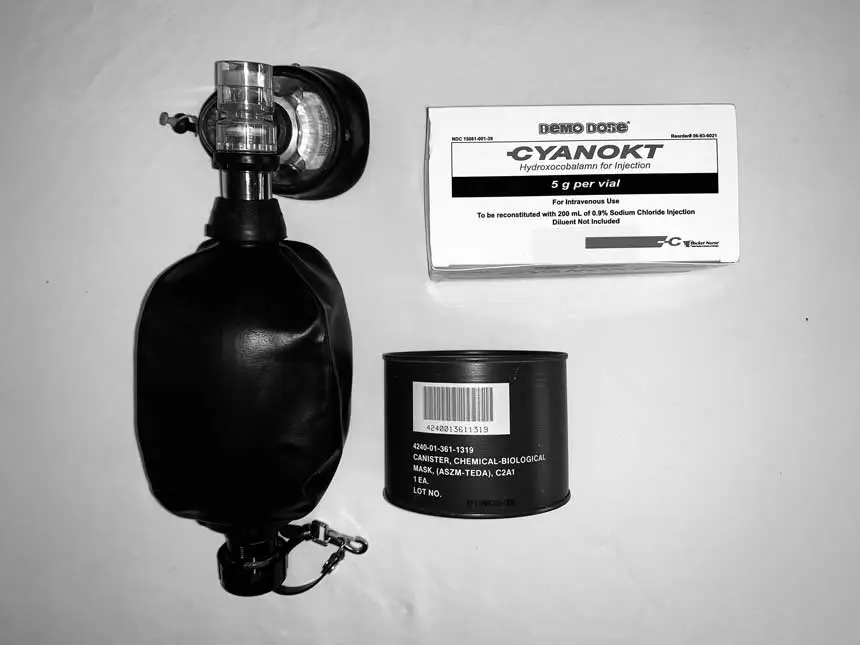
- “C” would include countermeasures to the agent, like airway suction, nebulizer treatments, etc. IV / IO access for a Cyanokit would technically be an antidote for cyanide poisoning but challenging in the hot zone. Access would be much easier to obtain in this phase of care.
- “H” would include both prevention of hypothermia during decontamination and evaluation of the casualty’s altered mental status to determine if the agent is responsible or do they have TBI?
- “E” is a reminder that CBRN casualties present extraction difficulties secondary to incomplete decontamination (trying to get the casualty 100% clean will compromise their treatment), fear of receiving providers even if fully decontaminated, etc.
MARCHE2 gives you an easy way to remember what to do and when
To say that managing casualties in both high-risk and CBRN environments is challenging is a massive understatement, but with the MARCHE2 model proposed by DeFeo and Givens, you have an easy way to remember what to do and when.
For an easy way to stay up to date on Tactical-CBRN topics, Crisis Medicine publishes a quarterly journal, free to subscribe to and to review
Key Takeaways
- In a CBRN environment the triage question is not only what is killing the casualty now, but whether it is the agent or the wound. A mustard casualty with massive hemorrhage dies of the bleeding first.
- Hot zone work is MAR2: mask up, antidotes if the agent will kill before decontamination can happen, and rapid spot decontamination. Anything you would not do while taking fire does not belong at the point of contamination.
- Rapid spot decontamination is the goal, not perfect decontamination. Getting the casualty 100% clean will compromise their treatment.
- CHE2 work waits for the warm zone: countermeasures, IV and IO access, hypothermia prevention during decontamination, sorting agent effect from TBI, and the extraction problems that come with a casualty who is not perfectly clean.
- MARCHE2 does not make CBRN casualty care simple. It reuses a mnemonic responders already know so the sequence is one less thing to recall under load.
Reference
Tactical CBRN Casualty Care – ONLINE