How Common Is an Isolated Femur Fracture
Isolated midshaft femur fractures occur in 10 per 100,000 person-years, making this an uncommon injury. Because femur fractures result from high-energy trauma, the literature shows a 40% rate of concurrent knee injury on the same extremity.1
Contraindications to Traction Splints
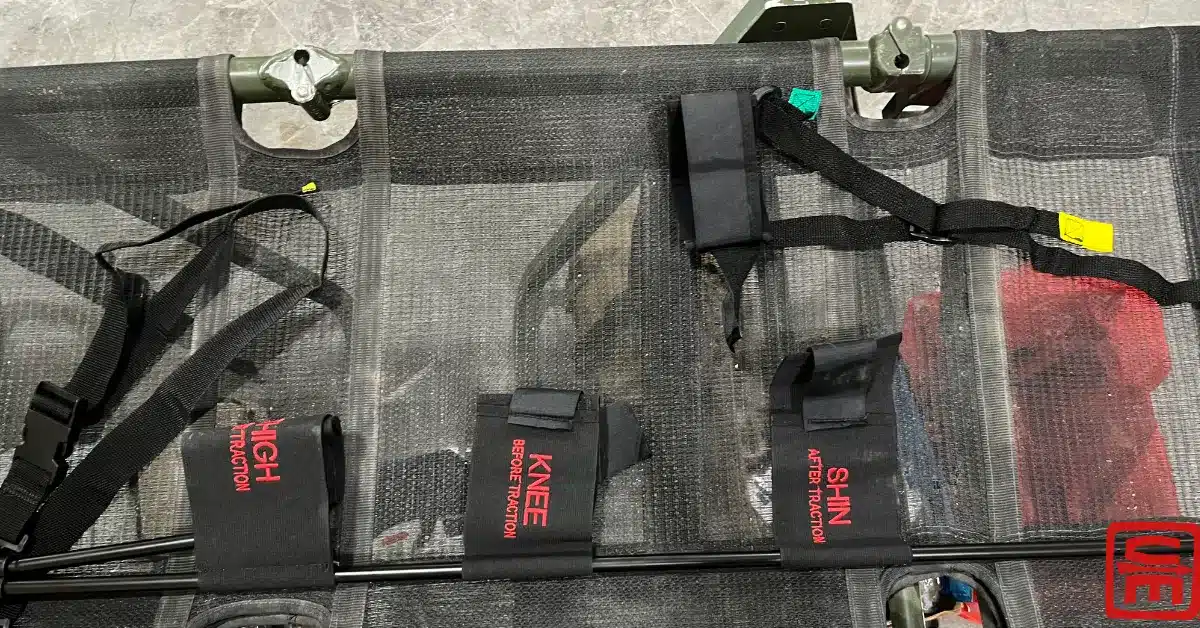
A traction splint pulls directly on the foot. Fractures of the foot, tibia, or fibula are contraindications to its use, because the traction required to stabilize a femur fracture would displace those fractures instead. Pelvic fracture and partial lower extremity amputation are contraindications as well.1
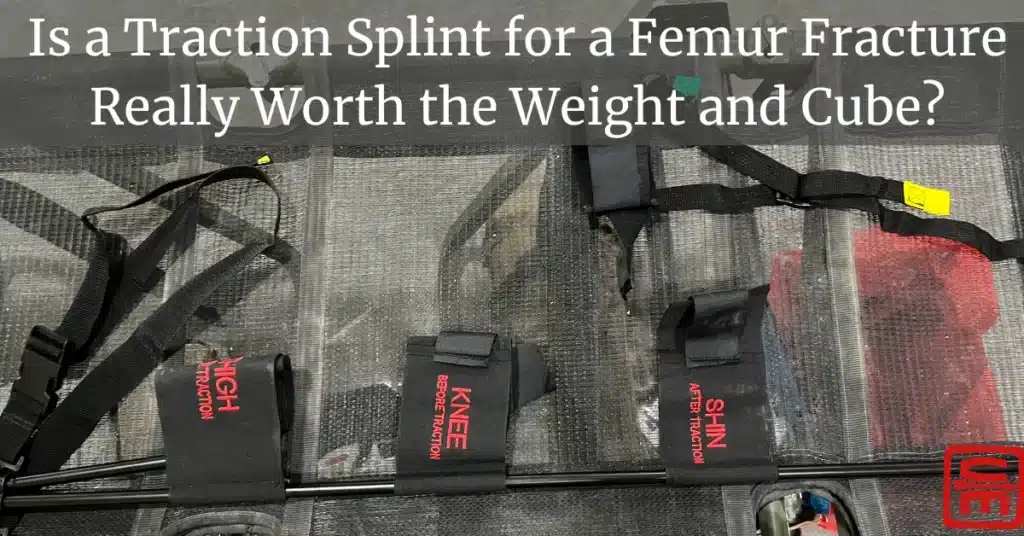
With that many contraindications, is a traction splint worth carrying?
A Brief History
The Thomas splint was designed for in-hospital femur fractures in 1875. The British and French militaries fielded it during World War I. It reportedly saved lives in open femur fractures from gunshot wounds, though no studies exist to confirm this.2
What the Evidence Shows
The IDF Experience
IDF physicians in 2007 considered traction splints essential for wartime extremity injuries, but with a caveat: they should be reserved for isolated femur fractures and gunshot wounds in casualties without concomitant life-threatening injuries. The same physicians noted that tourniquets should not be used for femur fractures without significant external bleeding, citing likely failure and potential further injury. We would still place a tourniquet for a femoral artery bleed associated with an open femur fracture.2 Though, I’ve never seen this, nor has a trauma surgeon with over 30 years at level 1 centers based on a recent discussion.
The Iranian Pain Study
A qasi randomized Iranian study of 32 patients with femur fractures compared pain scores immediately after splinting with either a traction type device or conventional immobilization without traction. There was no difference in pain scores on a visual analog score immediately after splinting, but at 1, 6, and 12 hours after splinting traction was superior for pain reduction. However, clinically meaningful reduction in pain scores is felt to require a reduction of 1.3 to 2 points.3
At 1 hour post splinting, the difference in pain scores were close to 1.3, but technically not significant as the actual change was 1.2. At 6 hours traction splints did show a pain reduction of 1.4 points favoring traction, but just barely. At 12 hours it was a change of 1.1.4
The Life in the Fastlane Review
Life in the Fastlane published a literature review of traction splints, although it did not include the Iranian study above.5 Their conclusion: only five studies exist cumulatively providing very little evidence. Traction splints are often applied to casualties who have contraindications to their use, take up significant space, and show minimal evidence of benefit. Even the IDF acknowledges a traction splint may not be needed in an urban setting, noting that simply tying the casualty’s legs together may be adequate for fracture mobilization.5
The 2023 Systematic Review
A 2023 systematic review found that all fracture splinting reduces pain, but found no clear benefit of a traction splint over regular splinting for a femur fracture specifically. The review did cite literature suggesting a possible reduced need for blood products when a traction splint is applied. Beyond that, the authors found no other evidence of benefit.6
Bottom Line
In an established medical treatment facility, even a Role 1, keeping a traction splint on hand is reasonable. In a rucksack or aid bag, the evidence does not justify the weight and cube. Most femur fracture casualties present with other injuries that contraindicate traction splint placement anyway.
References
1 Davis DD, Ginglen JG, Kwon YH, Kahwaji CI. EMS Traction Splint. [Updated 2023 Jul 24]. In: StatPearls [Internet]. Treasure Island (FL): StatPearls Publishing; 2026 Jan–. PMID: 29939619.
2 Sacred Cow Slaughterhouse: The Traction Splint. https://www.emsworld.com/article/11542786/sacred-cow-slaughterhouse-traction-splint
3 Sadovsky R. American Family Physician. 2002;65(9):1916-1921.
4 Irajpour A, Kaji NS, Nazari F, Azizkhani R, Zadeh AH. A comparison between the effects of simple and traction splints on pain intensity in patients with femur fractures. Iran J Nurs Midwifery Res. 2012 Nov;17(7):530-3. PMID: 23922601; PMCID: PMC3730458.
5 Femoral traction splints, helpful or not. https://litfl.com/femoral-traction-splints-helpful-or-not/
6 Philipsen SPJ, Vergunst AA, Tan ECTH. Traction Splinting for midshaft femoral fractures in the pre-hospital and Emergency Department environment – A systematic review. Injury. 2022 Dec;53(12):4129-4138.