🕖 Reading Time, 4 minutes
Researched and written by Mike Shertz, MD/18D, not AI
Oral transmucosal fentanyl citrate (OTFC) was recently removed from the TCCC guidelines. It wasn’t removed because new literature showed it doesn’t work or causes complications. It was removed because the US manufacturer stopped making it.
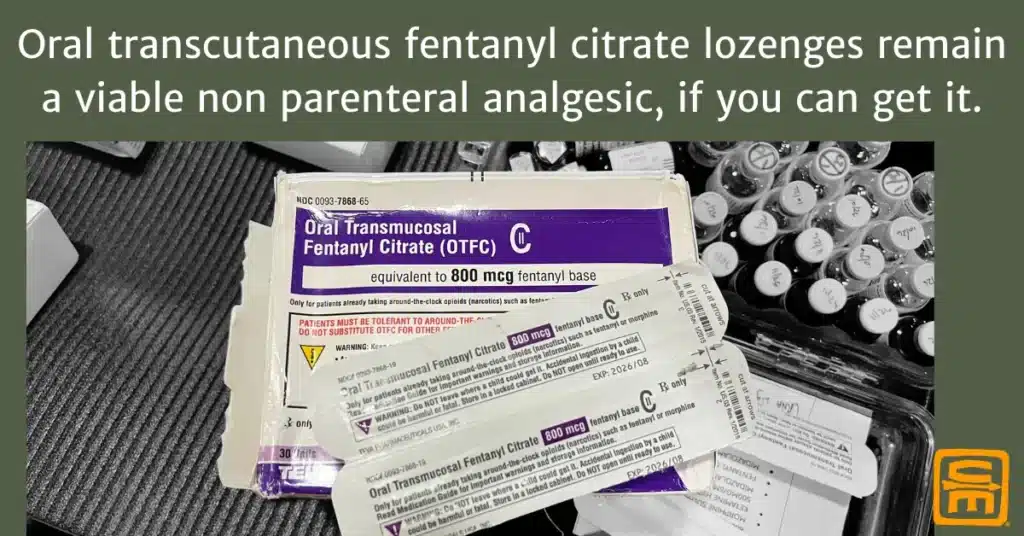
Subsequently, the Co-TCCC dropped it simply because it’s no longer available in the US. This can be confusing to deployed medical providers who might still have unexpired fentanyl lozenges as pictured here.
Can You Still Use Them?
The JTS CPG on “Pain, Anxiety, and Delirium” still lists OTFC as an option for Role 1 pain control. That CPG was last updated 27 March 2025. The current TCCC guidelines, which no longer mention OTFC as an option, were published 1 May 2026.
That means the two references are now out of sync. One still endorses it, the other has quietly dropped it.
What the Evidence Shows
An early Global War on Terror study showed 800 mcg OTFC provided adequate analgesia by 5 minutes, with 80% of recipients adequately controlled by 10 minutes. Effects lasted 3.5 hours. Respiratory depression and sedation were comparable to 10 mg IV morphine. Nausea occurred in 10% of recipients.1
A US military study out of SOCOM followed 197 casualties who received OTFC, recording pain scores before treatment and at 15 and 30 minutes after. Mean pain scores (0–10 scale) dropped from 8.0 pretreatment to 3.2 at both 15 and 30 minutes. Dosing was highly variable, from 400 mcg up to 3,200 mcg in one patient, with a mean dose of 962 mcg. The most common minor side effect was nausea, at 12.7%.2
A retrospective cohort study of 365 trauma patients in the Swiss Alps who received 800 mcg OTFC showed an average pain reduction of 32%. No serious adverse events were noted.3
A retrospective analysis of 190 London HEMS trauma patients who received 400 mcg OTFC between 2019 and 2020 found minimal adverse effects — two patients reported nausea requiring lozenge removal, and no one experienced drowsiness or respiratory depression.4
Bottom Line
OTFC is a useful and effective analgesic delivered by a non-parenteral route. It remains a viable option for acute pain control in the right setting. Its availability in the US, however, is now extremely limited, although it is still manufactured outside the US, and may still be available in kits assembled when it was still available to US forces.
References
1Aronoff GM, Brennan MJ, Pritchard DD, Ginsberg B. Evidence-based oral transmucosal fentanyl citrate (OTFC) dosing guidelines. Pain Med. 2005 Jul-Aug;6(4):305-14.
2Wedmore IS, Kotwal RS, McManus JG, Pennardt A, Talbot TS, Fowler M, McGhee L. Safety and efficacy of oral transmucosal fentanyl citrate for prehospital pain control on the battlefield. J Trauma Acute Care Surg. 2012 Dec;73(6 Suppl 5):S490-5. doi: 10.1097/TA.0b013e3182754674. PMID: 23192075.
3Pietsch U, Bommer A, Hossfeld B, Wenzel V, Meier R, Albrecht R, Rüst CA. Oral transmucosal fentanyl citrate analgesia in prehospital trauma care: a retrospective observational cohort study focusing on age and gender differences. Scand J Trauma Resusc Emerg Med. 2026 Jan 6;34(1):27.
4Carenzo L, McDonald A, Grier G. Pre-hospital oral transmucosal fentanyl citrate for trauma analgesia: preliminary experience and implications for civilian mass casualty response. Br J Anaesth. 2022 Feb;128(2):e206-e208.