

Researched and written by Mike Shertz, MD/18D, not AI
🕖 Reading Time, 4 minutes
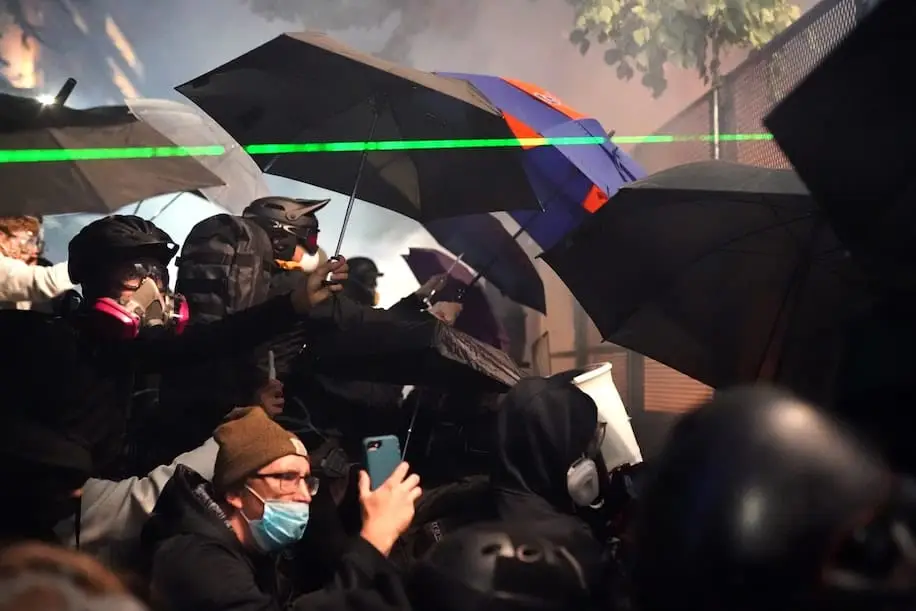
When both national and international attention focused on the Pandemic-era violence in Portland, Oregon, one unique injury pattern suffered by LEO emerged: intentional laser eye injuries. As an indication of their ability to cause serious eye damage, the use of lasers as a weapon violates the Protocol IV of the 1980 Convention on Certain Conventional Weapons. (Adopted at Vienna on 13 October 1995 and in force since 30 July 1998.)
However, protestors in Portland reportedly used them against LEO.
Laser pointer injuries primarily involve photothermal damage to the eye, specifically, the retina, which receives light through the lens, converts it to neural signals and transmits those signals to the brain.
“Depending on the wavelength, radiation power, exposure time, localization, and spot size, laser pointers can cause extreme photothermal injury to the eye, which can lead to blindness.”1
For illustrative photos, we recommend viewing the phootgraph that is part of a Washington Times article and photograph 17 of 32 in the KSAT article on Portland protests showing lasers shining in at tactical officers in the Federal Courthouse lobby
Although laser power output is federally regulated to keep dangerous high-power lasers from causing unintentional injury, many high-power lasers imported into both the US and Europe are either inaccurately labeled with regard to their power output, not labeled at all, or correctly labeled, but of an output that they should not have been allowed for public sale.
Most laser pointers are regulated to a power output of 1 mW, which is relatively harmless under most circumstances. Radiation output of the measured lasers causing injury has varied from less than 5mW to over 1000 mW.1
One laser pointer tested in a German lab had an actual output 100 times what was listed.1 Two devices were labeled as 1 mW but powered at 45 mW. In another case, a device labeled at less than 5 mW was actually putting out 105 mW.
These high output lasers often emit light in the green spectrum, which, in contrast to red lasers, occurs at different wavelengths, including invisible infrared radiation. The shorter wavelength of the green light causes more pronounced photothermal damage.1 In one study 90% of green laser pointers tested had power outputs greater than 5 mW, the threshold for “high-powered” lasers.3
As the retina absorbs radiant energy, the tissue heats up, leading to protein denaturation, edema of the retina, an inflammatory reaction, and cell death. Retinal hemorrhage has been reported as well.
As of December 2018, the published medical literature documented 171 cases of laser pointer eye injuries. Approximately half of all patients presented 1 to 7 days after laser exposure.2 The typical course of laser pointer retinal damage is one of sudden vision loss, sometimes after a sense of a ‘bright flash” of light, followed by an improvement in visual loss over a number of weeks.
Statistically, the injuries break down into: one third involving both eyes, one third the right eye, and one third the left.1 Upon first presentation the mean visual acuity after exposure was 20/50 2, less than 20/40 in 55%1 and 5 to 7.1% could only count fingers.1,2
Some of the injured reported mild headaches, tearing, and floaters in their vision. More than 90% have some degree of decreased vision, blind spots, or blurry vision.2 Most retinal damage is painless. Only 9.1% reported eye pain, often more than 24 hours after exposure.2
Some casualties may rub their eye hard enough to cause a corneal abrasion, which can be very painful. These corneal abrasions aren’t directly the result of the laser damage itself.
Unfortunately, both prehospital and emergency department treatment is limited, largely ruling out more common occular injuries. Eye shields don’t have any definite benefit unless there is a concern for direct blunt or penetrating trauma to the eye. Unnecessary shielding will make it more difficult for the casualty to see, reducing them to essentially one open eye.
An ophthalmologic referral is mandatory, but the ophthalmologist’s options are limited as well. While both topical and systemic steroids have been used, there is conflicting data on whether they improve the casualty’s ultimate visual acuity. Even in those with improved vision, none have a full recovery, and all continue to show persistent retinal scars, even if their ultimate vision is 20/20.1
This tactic has also been used in the UK, Hong Kong, and Chile.
UPDATE 10 August 2020: DHS reporting 113 eye injuries, as reported in the New York Post. From that article: “We’ve had a number of officers who have days-long blindness. So far they’ve all kind of come back, if you will,” Cuccinelli said. “But you also get what’s called flash blindness. Think of it as the old Kodak cameras where you get that blue spot and you can’t quite see your entire field of vision for a period.” Acting Deputy Secretary of DHS, formally Senior Official Performing the Duties of the Deputy Secretary.
1 Birtel J, Harmening WM, Krohne TU, Holz FG, Charbel Issa P, Herrmann P. Retinal Injury Following Laser Pointer Exposure. Dtsch Arztebl Int. 2017 Dec 8;114(49):831-837. doi: 10.3238/arztebl.2017.0831. PMID: 29271340; PMCID: PMC5754573.
2Bhavsar KV, Michel Z, Greenwald M, Cunningham ET Jr, Freund KB. Retinal injury from handheld lasers: a review. Surv Ophthalmol. 2021;66(2):231-260. doi:10.1016/j.survophthal.2020.06.006. PMID 32628946.
3 Hadler J, Tobares E, Dowell M. Random testing reveals excessive power in commercial laser pointers. J Laser Appl. 2013;25:032007.
[maxbutton id=”1″]