
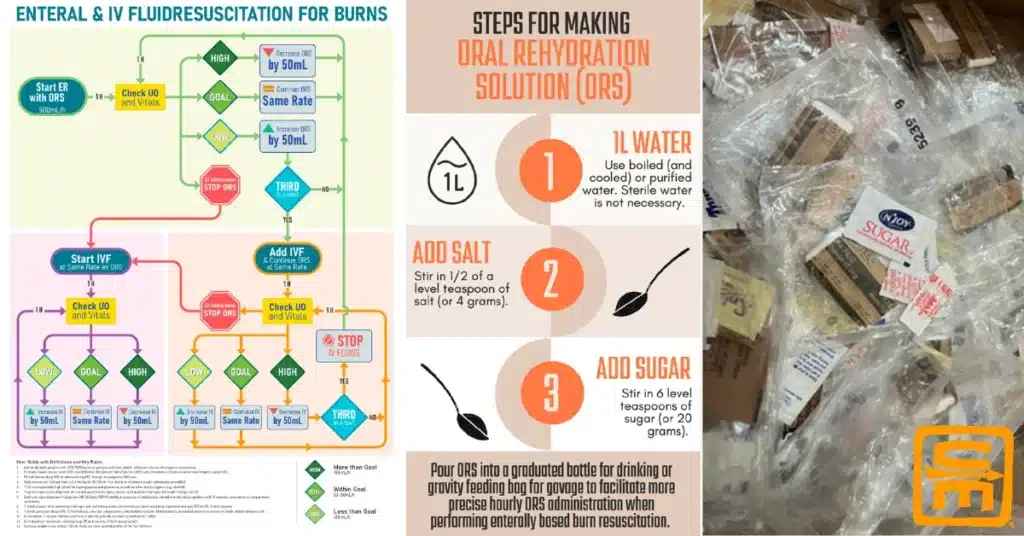
The US Joint Trauma System Clinical Practice Guideline on Burn Care, published June 10, 2025, now includes enteral resuscitation, meaning oral or nasogastric (NG) tube fluids, for burn casualties when IV fluid isn’t available in the quantities required.
Oral fluids require a casualty who is awake, reasonably alert, and cooperative. NG tube resuscitation is an option as long as the casualty can protect their airway. Rectal fluid administration remains available for those who can’t safely swallow.
Anything that limits the gastrointestinal tract’s ability to absorb fluid is a contraindication. That includes abdominal injuries, vomiting, and burns exceeding roughly 40% total body surface area (BSA). Larger burns typically require intubation and aggressive airway control anyway, which takes oral resuscitation off the table. An NG tube is still an option; just weigh the aspiration risk.
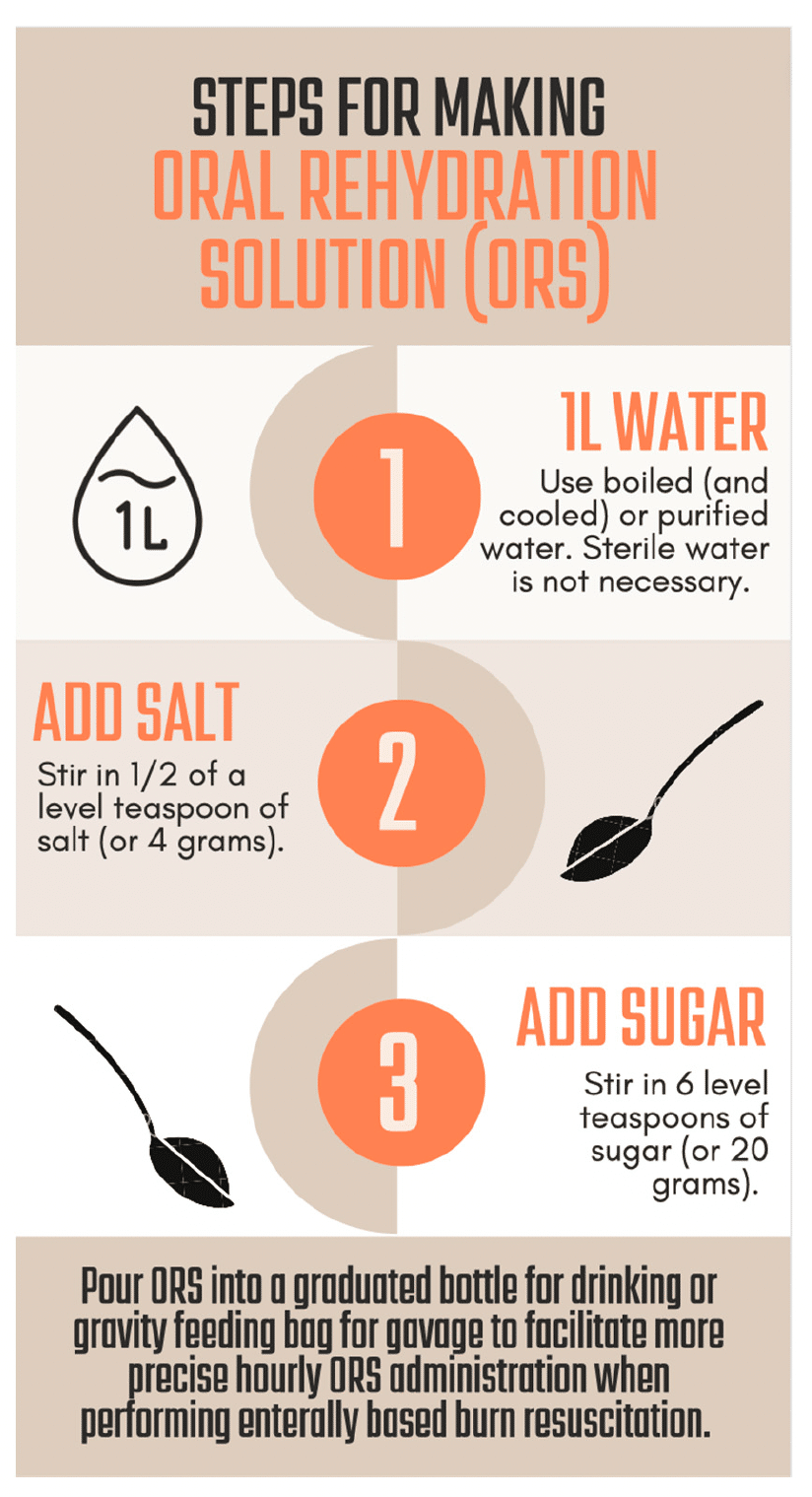
Enteral resuscitation requires an electrolyte-based solution. World Health Organization Oral Rehydration Salts (ORS), or a commercial variant, is the most available option in austere or deployed settings. The fluid has to be isotonic: tap water or Gatorade will dilute the casualty’s electrolytes and create a new problem instead of solving the original one.
Useful in theory. But what does the evidence actually say?
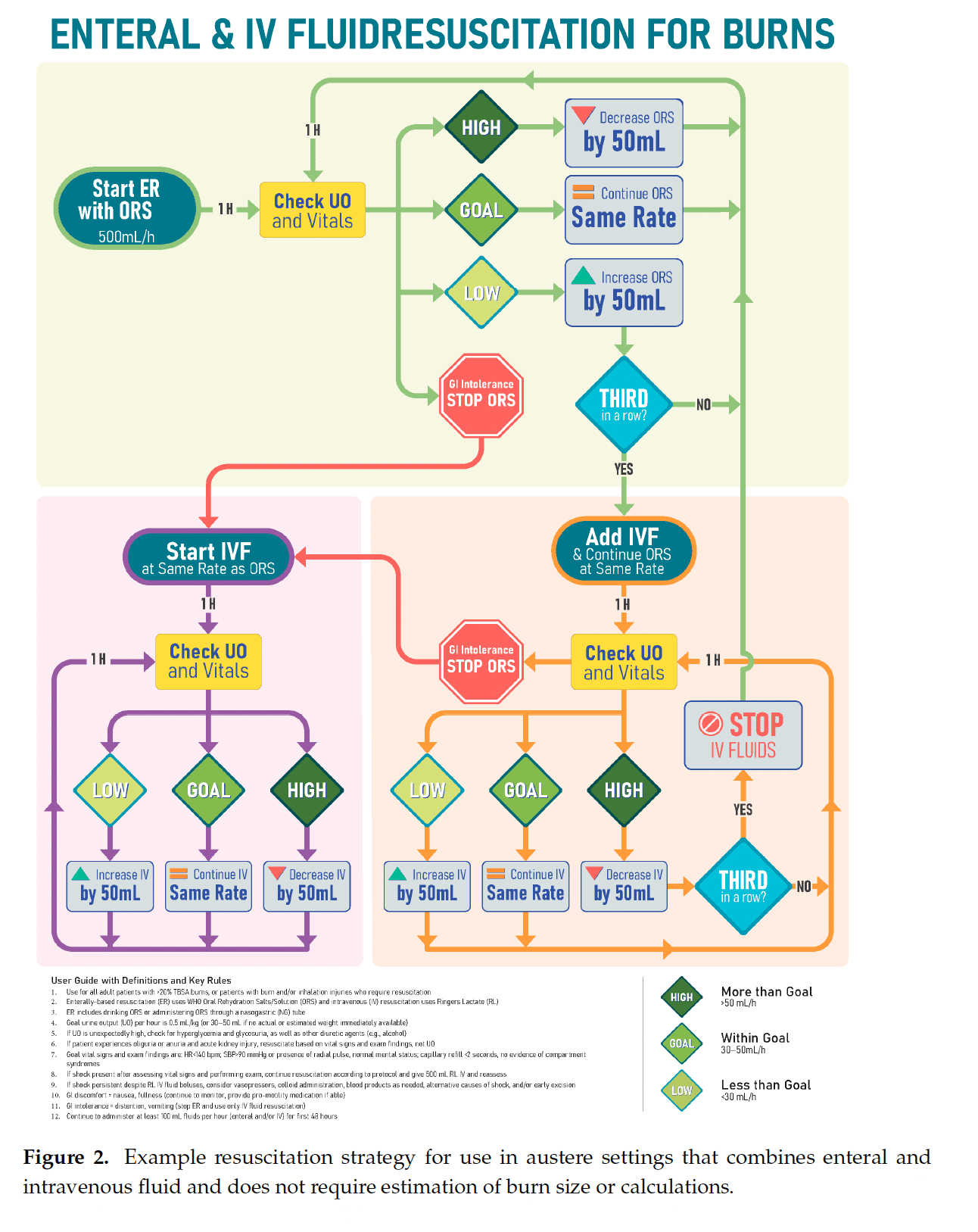
In 1950, an NIH Surgery Study Section specifically adopted oral saline solution “as standard practice in the treatment of shock due to burns and other serious injuries in the event of large-scale civil catastrophe.” Many in the field believe this technique was simply forgotten once IV fluids and plastic IV catheters became widely available.1
The earliest supporting experiments used mice with trauma, traumatic shock, or burns. A standard “shock model” produced greater than 50% mortality within six hours. Oral resuscitation with isotonic fluid delivered a “great survival benefit” in that model. Pure water or glucose solutions did not improve survival.1
Between 1944 and 1991, 709 human patients with “moderate to severe” burns received enteral resuscitation across 12 studies. That data helped refine the solution itself: early formulas using only sodium chloride caused acidosis, which isn’t surprising, since aggressive 0.9% normal saline resuscitation causes hyperchloremic metabolic acidosis by the same mechanism.
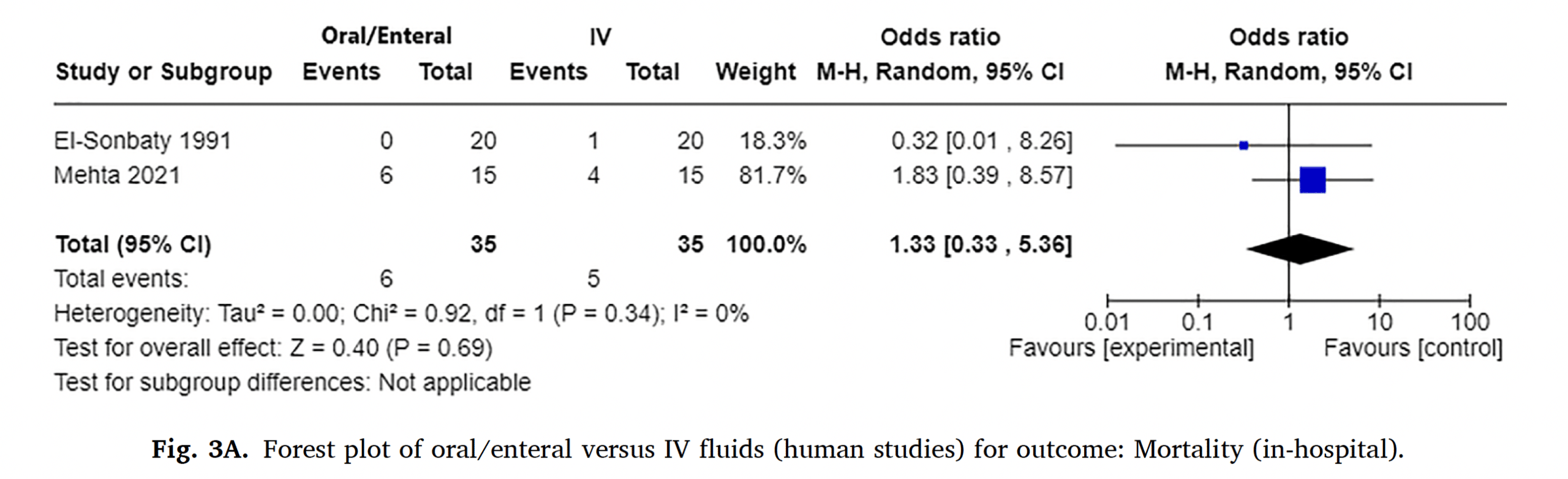
The remaining studies were conducted in dogs, pigs, and rats. Compared to no fluid at all, enteral fluids significantly improved mortality, kidney function, and urine output in these animal models.
Authors examining this question from a military field-expedient standpoint point out that ORS packets are dramatically lighter and lower-cube than IV fluid. They cite International Society of Burn Injuries guidelines recommending burn casualties drink 15% of body weight (kilos × 0.15 = liters) in fluid over the first two days post-burn; the WHO working group on burns uses a figure closer to 10% body weight daily. These authors also acknowledge, as is true everywhere in this literature, that there is very little hard evidence to support “strong guidelines.”3
There is some evidence supporting enteral burn resuscitation, particularly for casualties under 40% BSA. In a deployed setting, blood may be plentiful while IV fluid is not, and burn casualties, especially in a mass casualty incident, can require volumes of IV fluid you simply may not have. Smaller burns can reasonably be resuscitated orally, preserving limited IV fluid for the larger burns that need it.
The evidence for enteral burn resuscitation is limited but real. Treat it as your alternate plan when resources run short, not your primary plan. IV fluid remains primary.
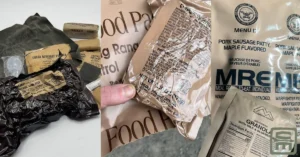
…And now you finally have a use for all those MRE accessory packets (containing salt and sugar so you can make your own ORS) you’ve been throwing in a box on deployment.
The addendum to the Burn Care CPG outlining exactly how to administer enteral burn resuscitation: Burn Care CPG, 10 June 2025 (PDF)
1Kramer GC, Michell MW, Oliveira H, Brown TL, Herndon D, Baker RD, Muller M. Oral and enteral resuscitation of burn shock: the historical record and implications for mass casualty care. Eplasty. 2010 Sep 1;10:e56.
2Hsiao KH, Kalanzi J, Watson SB, Murthy S, Movsisyan A, Kothari K, Salio F, Relan P. Oral/enteral fluid resuscitation in the initial management of major burns: A systematic review and meta-analysis of human and animal studies. Burns Open. 2024 Nov;8(4).
3Jones IF, Nakarmi K, Wild HB, Nsaful K, Mehta K, Shrestha R, Roubik D, Stewart BT. Enteral Resuscitation: A Field-Expedient Treatment Strategy for Burn Shock during Wartime and in Other Austere Settings. Eur Burn J. 2024 Jan 18;5(1):23-37. doi: 10.3390/ebj5010003. PMID: 39600011; PMCID: PMC11571826.