In a study of 5 portable, battery-powered blood warmers, only the MEQ MWarmer could heat cold-stored whole blood to body temperature at pressure bag infusion rates.
Researched and written by Mike Shertz, MD/18D, not AI
🕖 Reading Time, 3 minutes
The Thermal Angel, Buddy Lite, and Quantum could not heat cold-stored whole blood to body temperature at pressure bag infusion rates. . The QinFlow Warrior Lite had intermediate final temperatures while delivering moderate flow.
There is a concern that prehospital transfusion of one unit of cold whole blood may decrease a casualty’s body temperature by 1.3 degrees Celsius. Other data has shown that for every 1 degree Celsius the casualty’s body temperature drops, their death rate increases 10%.
Whole blood has a higher viscosity and “greater heat transfer requirements” compared to IV fluid or a similar volume of packed red blood cells.
So the question is: What is the ability of portable, battery-powered blood warmers to deliver warmed blood to the casualty?
The TCCC Guidelines recommend blood warmers deliver 38°C blood at flow rates of up to 150 mL per minute.
Five warmers, tested at gravity and with a pressure bag
In a study of five commercially available blood warmers, QinFlow Warrior Lite, MEQ M Warmer, Thermal Angel, Buddy Lite, and Quantum (the last was discontinued and is no longer manufactured), compared flow rates and ability to warm cold (4° C) stored whole blood at both gravity flow (on an IV pole at 195 cm height) and with a pressure bag inflated to 300 mmHg. Use of a pressure bag to deliver blood was felt to represent typical damage control resuscitation practice.
Each warmer and flow situation, either gravity or pressure bag, was tested three times. The temperature of delivered heated blood was measured at the end of the IV tubing line.
Most warmers slowed the flow of blood
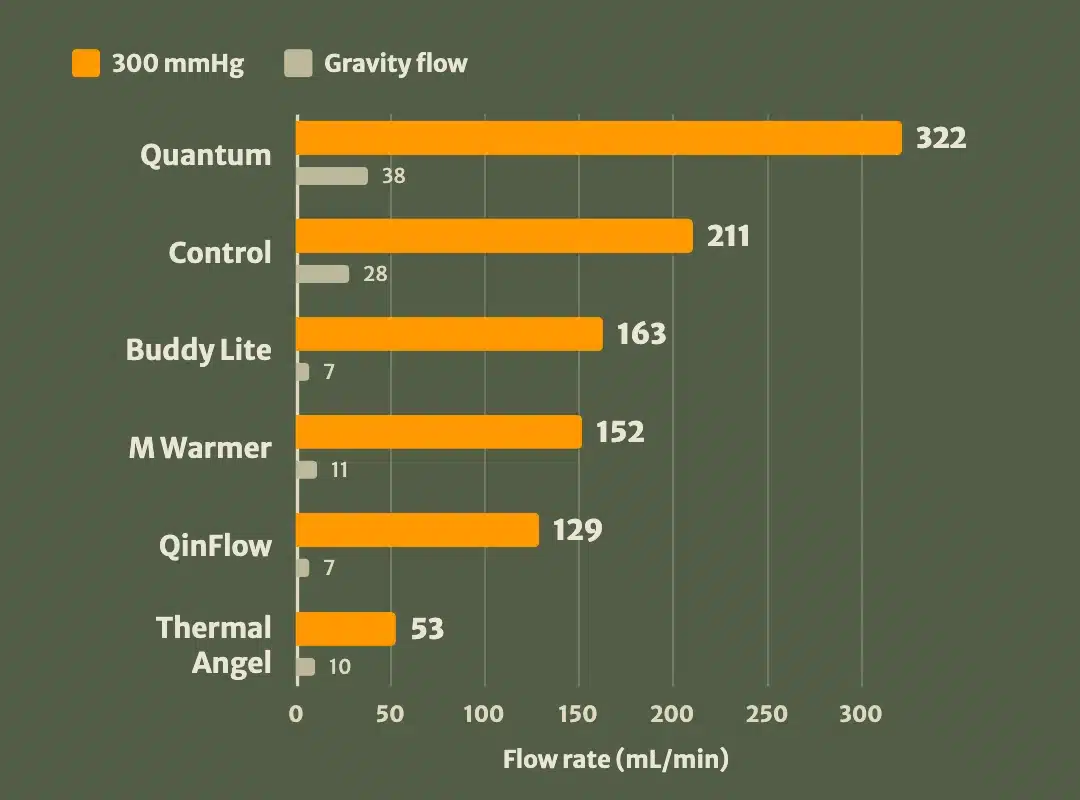
At gravity flow, all warmers except the Quantum slowed the delivery of whole blood. The reduction in flow rate varied from 2 to 4X compared to “control” blood run through the tubing, but with no heating element.
With a pressure bag inflated to 300 mmHg, the reduction in flow ranged from none to 3X slower. The Quantum, which had proprietary, larger tubing, had a pressure-bag flow rate 50% faster than other IV tubing/heating-element, pressure-bag combinations.
Under pressure, only the M Warmer held its temperature
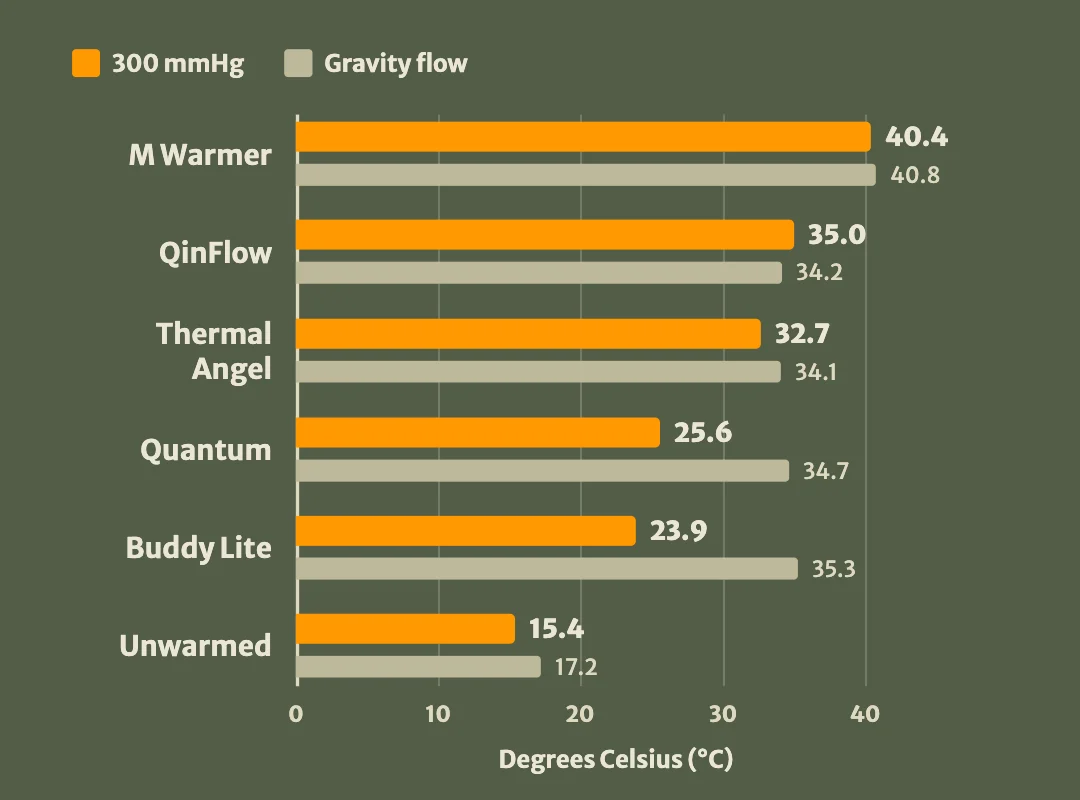
Increasing the flow rate / pressure of blood delivery decreased the final blood temperature in every device, except the M Warmer. The pressure bag resulted in several warmers being pushed to flow rates faster than their manufacturers’ specifications.
The M Warmer reached the highest final blood temperature of all warmers tested at both gravity (40.8°C) and pressure bag flow (40.4°C).
Both the Quantum and Buddy Lite had a markedly reduced final blood temperature when a pressure bag was used. Specifically, 9.1°C and 11.4°C decreases in final temperature, respectively. The other tested devices didn’t show any significant temperature changes.
The authors also tried wrapping a ReadyHeat Blanket, meant to be placed on a casualty for body warming, around the blood bag, but it didn’t increase temperature much at all compared to no warmer.
What does this mean to you?
If you want to deliver body temperature (37.9°) cold-stored whole blood quickly, you need a pressure bag and MEQ MWarmer. The second-best QinFlow Warrior Lite only had intermediate final temperatures (30.6°C) but delivered moderate flow.
This post is not sponsored and is FYSA only.
Crisis Medicine does not accept payment from industry nor do we use affiliate links. We review and present the medical literature. You can read our Dislcosures-None statement.
Reference
Papalski, W., Tovar, M. A., Sulava, E.(2026). Enhancing Far-Forward Resuscitation: A Quantitative Laboratory Analysis of Blood Warmer Devices Used in Austere Environments. Prehospital Emergency Care, 1–8. https://doi.org/10.1080/10903127.2026.2736179