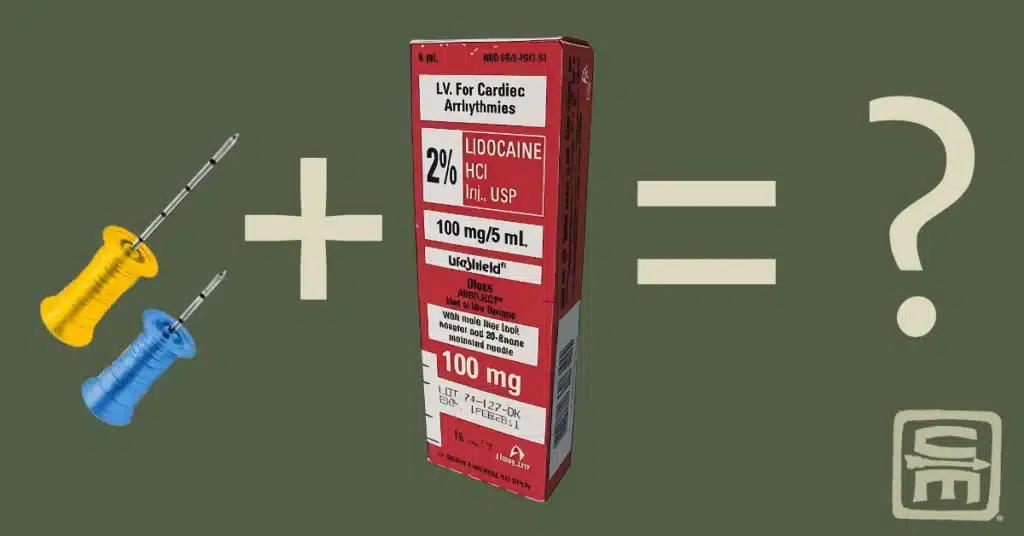
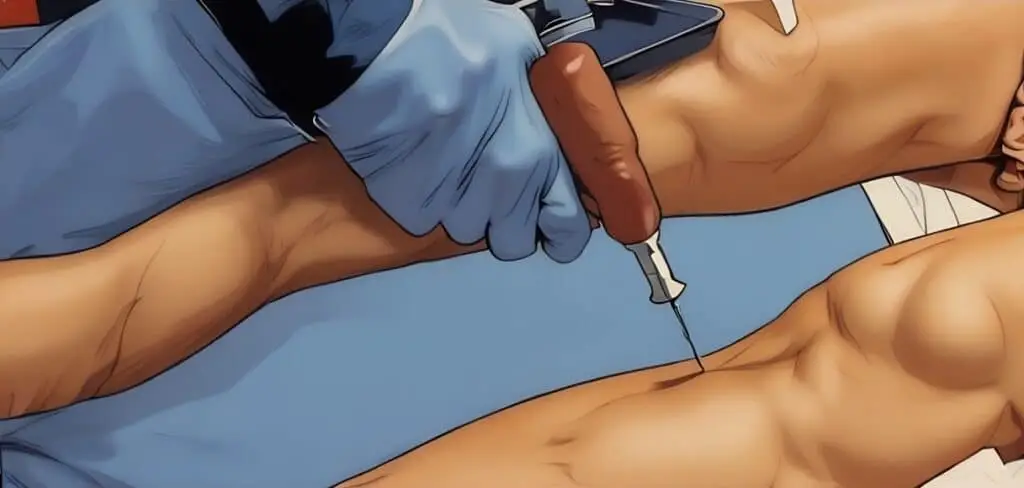
Studies suggest IO flushing is uniformly painful -especially tibial sites - and lidocaine may help, data remains limited.
Among 32 combat casualties treated by the UK in Afghanistan, all responsive patients reported pain with IO infusion. Three stated that IO infusion pain was worse than their traumatic injuries.2
In an abstract, never fully published, 10 adult volunteers, with proximal humerus IO access, received various doses of IO lidocaine followed by a “hard flush” of saline and additional lidocaine. On a visual analog scale, mean insertion pain was 3.9 +/- 1.5. After 20 mg IO lidocaine, the highest score was 2.0 +/- 1.2 at IO fluid administration pressures of 300 mmHg.4
The most detailed studies to look at the issue of IO associated pain were manufacturer associated and therefore at risk of bias. Two non-randomized studies involving 10 volunteers each underwent IO insertion at either the left / right proximal tibial or proximal humerus.
Mean insertion pain at the left tibia was 4.4 +/- 2.6, right tibia 3.6 +/- 2.3, and 3.0 +/- 1.5 for proximal humerus.
Left Tibial - 40 mg lidocaine over two minutes, flushed with 10 ml saline over five seconds, and finally an additional 20 mg lidocaine over thirty seconds.
Volunteers undergoing tibial insertion received different IO lidocaine dosing based on IO location.
Right Tibial - 80 mg lidocaine over two minutes, flushed with 10 ml saline over five seconds, and finally an additional 20 mg lidocaine over thirty seconds.
Proximal humerus - 40 mg lidocaine over two minutes, flushed with 10 ml saline over five seconds, and finally an additional 20 mg lidocaine over thirty seconds.
Pain was highest during the initial saline flush:
- All volunteers were observed for ninety minutes while undergoing IO fluid administration at 300 mmHg.
- Eighty percent of tibial participants required additional 20 mg IO lidocaine to keep their pain scores below 5. All had previously received 100 mg lidocaine.
- Mean elapsed time between initial and follow up lidocaine dosing was 39 +/- 20 minutes. No humeral IO volunteers (previously receiving 60 mg lidocaine) required follow up IO lidocaine dosing, again despite IO infusion rates 300 mmHg.3
Other authors acknowledge it is unclear if lidocaine administration after IO access decreases pain significantly or not. Reasonably, they note for conscious patients it takes little time, may help, and is unlikely to cause harm.
Therefore, based on the best available evidence:
1 – IO flushing is uniformly painful
2 – Humeral IO sites may have less associated pain than tibial sites.
3 – Flushing causes more pain than initial insertion.
4 – 40 mg IO lidocaine over two minutes, followed by rapid normal saline flush, then another 20 mg IO lidocaine over 30 seconds showed best pain control at the both the humeral and tibial sites.
5 – When additional lidocaine is needed it occurs at around 20 to 60 minutes post infusion initiation.
Clinical Note: If IO lidocaine is to be used, it must be preservative free, which is typical for the lidocaine in code carts, but not lidocaine used for wound anesthesia.
References
1Davidoff J, Fowler R, Gordon D, Klein G, Kovar J, Lozano M, Potkya J, Racht E, Saussy J, Swanson E, Yamada R, Miller L. Clinical evaluation of a novel intraosseous device for adults: prospective, 250-patient, multi-center trial. JEMS. 2005 Oct;30(10):suppl 20-23. PMID: 16382512.
2Cooper BR, Mahoney PF, Hodgetts TJ, Mellor A. Intra-osseous access (EZ-IO) for resuscitation: UK military combat experience. J R Army Med Corps. 2007 Dec;153(4):314-6. PMID: 18619171.
3Philbeck TE, Miller LJ, Montez D, Puga T. Research Abstract, Annals of Emed Med 2009.
4Philbeck TE, Miller LJ, Montez D, Puga T. Hurts so good. Easing IO pain and pressure. JEMS. 2010 Sep;35(9):58-62, 65-6, 68; quiz 69. doi: 10.1016/S0197-2510(10)70232-1. PMID: 20868946.
5Schalk R, Schweigkofler U, Lotz G, Zacharowski K, Latasch L, Byhahn C. Efficacy of the EZ-IO needle driver for out-of-hospital intraosseous access–a preliminary, observational, multicenter study. Scand J Trauma Resusc Emerg Med. 2011 Oct 26;19:65. doi: 10.1186/1757-7241-19-65. PMID: 22029625; PMCID: PMC3212886.