Surgical Airway With the NAR Tracheostomy Bougie Kit

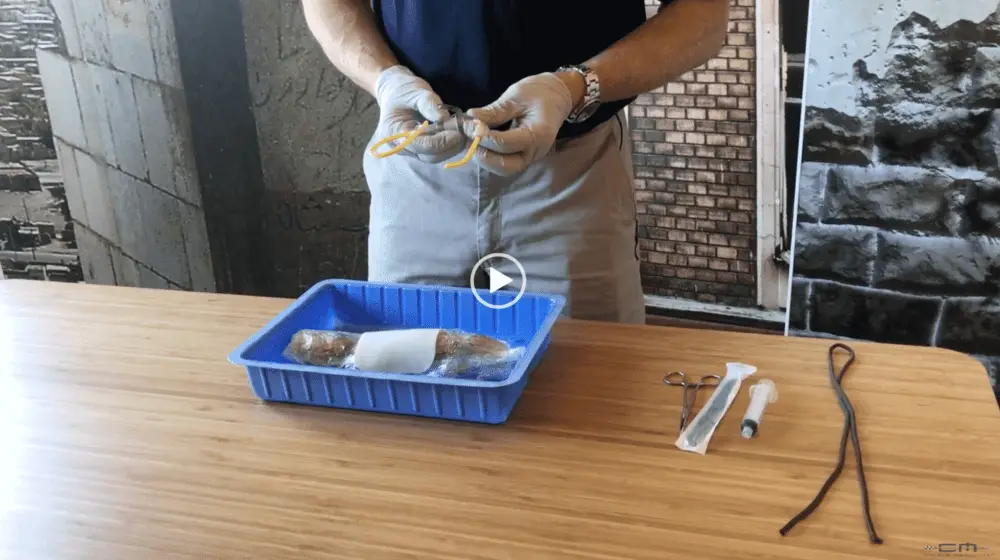
An excerpt from our CTC2 course demonstrates the skill station of performing a surgical airway with the NAR airway tracheostomy kit with bougie-introducer

Researched and written by Mike Shertz, MD/18D, not AI

🕖 Reading Time, 2 minutes

The bougie comes pre-inserted in the tube

The North American Rescue tracheostomy airway with bougie introducer is demonstrated in a surgical airway consistent with TECC/TCCC guidelines for airway managment. This is an excerpt from one of the many skills stations in our online Complete Tactical Casualty Care course skills station.

From NAR’s website: “The North American Rescue Tracheostomy Kit with Bougie-Introducer is a convenient device that gives the user a pre-inserted bougie for introduction of the tube into the trachea and indication of correct placement prior to insertion. The bougie-introducer is adjustable for maximum user preference, and the excess can be tucked into the included cap that rests on top of the tracheostomy tube. Contains the same preferred flexible tube as NAR’s Tactical CricKit®. This latex free tube is sterile and has a 6.0mm inner diameter and an inflatable cuff.”

Using the device still begins with a standard surgical airway

To use this device, you need to begin with the standard surgical airway:

  • Prepare your equipment. This device comes out of the package very tightly twisted and requires some manipulation to straighten it out.

  • Locate the cricothyroid membrane.
    • Establish positive position on the chin of the casualty.
    • Trace down the neck to find the Adam’s apple.
    • Continue marching your index finger downward and you will fall into a trench where the cricothyroid membrane is located.
    • Continue the march downward to ensure proper positioning, feeling the cricoid cartilage, then tracheal rings.
    • March back up to the established cricothyroid location.

  • Using a scalpel, cut through the soft tissue and cut down to the cricothyroid membrane making a vertical incision (parallel to the throat/neck).

  • When you can visualize the cricothyroid membrane, pop through it with the scalpel and maintain positive control over the hole once established

  • Insert the bougie into the surgical airway hole.

  • This should allow the tube to slide easily into the surgical airway.

  • Remove the bougie introducer to allow air to flow through the tube.

  • Secure the airway in place with the included straps.

The full surgical airway sequence is taught in the CTC2 course

Interested in more?
You can learn about surgical airways in our Complete Tactical Casualty Care course.

For the outcome data on surgical cricothyrotomy compared with intubation, see our review of the long-term disability findings.

This post is not sponsored and is FYSA only.

Crisis Medicine does not accept payment from industry nor do we use affiliate links. We review and present the medical literature.  You can read our Dislcosures-None statement.

Picture of Mike Shertz MD/18D

Mike Shertz MD/18D

Dr. Mike Shertz is the Owner and Lead Instructor at Crisis Medicine. Dr. Shertz is a dual-boarded Emergency Medicine and EMS physician, having spent over 30 years gaining the experience and insight to create and provide his comprehensive, science-informed, training to better prepare everyday citizens, law enforcement, EMS, and the military to manage casualties and wounded in high-risk environments. Drawing on his prior experience as an Army Special Forces medic (18D), two decades as an armed, embedded tactical medic on a regional SWAT team, and as a Fire Service and EMS medical director. Using a combination of current and historical events, Dr. Shertz’s lectures include relevant, illustrative photos, as well as hands-on demonstrations to demystify the how, why, when to use each emergency medical procedure you need to become a Force Multiplier for Good.