

Change in CAT tourniquets from 6th to 7th generation 🕖 Reading Time, 4 minutes In October 2015, the 6th generation Combat Application Tourniquet, or CAT, with its double-eyelet buckle was discontinued, in favor of the 7th generation CAT which has …

The easy to remember mnemonic MARCH reminds us of the priorities in treating casualties during TECC and TCCC situations. MARCH provides a framework to address immediate life threats and gives an organized approach to begin a casualty evaluation. The MARCH mnemonic is preferable to the ABCDE model because it takes into consideration the reason you need an airway and to be breathing is to circulate blood to the casualty’s brain. Recognizing that, the first step in our casualty evaluation should be to look for massive hemorrhage.
Once past massive hemorrhage, A-R-C is loosely approximated by A-B-C. H- is a reminder that a large number of traumatic casualties arrive at the emergency department or medical treatment facility hypothermic which dramatically increases their death rate.
The MARCH mnemonic can be applied to any patient, as the initial casualty evaluation usually rules out massive hemorrhage.
Change in CAT tourniquets from 6th to 7th generation 🕖 Reading Time, 4 minutes In October 2015, the 6th generation Combat Application Tourniquet, or CAT, with its double-eyelet buckle was discontinued, in favor of the 7th generation CAT which has …

Knowing the quantity of blood loss helps estimate the likelihood of shock Researched and written by Mike Shertz, MD/18D, not AI 🕖 Reading Time, 5 minutes Having a sense of how much blood a trauma patient “spilled” on the ground …

Once a casualty’s massive hemorrhage is controlled, rescuers must turn our attention to the rest of the M-A-R-C-H pneumonic, specifically, to hypothermia prevention. Does the casualty have an open airway, or do they need help maintaining their airway? How are …
🕖 Reading Time, 1 minutes An OPS Core Helmet or Cairns Fire Helmet used to stop junctional hemorrhage with two CAT tourniquets. Proof of concept of a junctional hemorrhage tourniquet idea first suggested by Full Spectrum Training, now proven with …
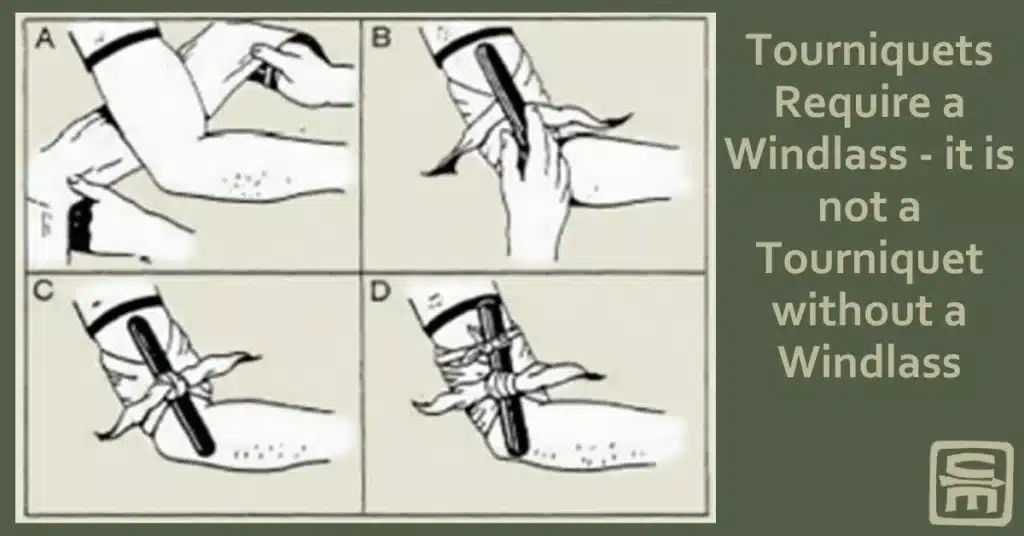
It is not a tourniquet if if does not have a windlass. 🕖 Reading Time, 7 minutes Recent news articles describe many cases of the public placing “tourniquets” without windlasses on injured individuals to stop bleeding. However, if you look …

The safety pin is a versatile and useful piece of equipment that has been around for over 150 years. Each military cravat comes with two and this video demonstrates ways…