
Call: 503/765-7615

Logistics@crisis-medicine.com

Login
$0.00 0 Cart
The Crisis Medicine Logo, a C and M with an arrow intersecting them
  • Solutions
    • TCCC and TECC Concepts
    • Training for Law Enforcement
    • Training for Fire & EMS
    • Training for Private Citizens
    • Training for EDC
    • Training For Faith Communities
    • Training For Teachers
  • Courses
    • Explore Training
    • TCCC & TECC Courses Online
    • 2026 In-Person Training
    • Which Course is Right for Me?
  • Company
    • About Crisis Medicine
    • Agency Pricing
    • Contact
    • CM in the Media
    • Disclosures – None
    • Lessons Learned in Blood
    • Frequently Asked Questions
  • Read
    • New
    • Quick Tips
    • MARCH
      • (S) Security & Awareness
      • (M) Massive Hemorrhage
      • (A) Airway
      • (R) Respiration
      • (C) Circulation
      • (H) Hypothermia Prevention
    • Everything Else
    • Equipment
    • Improvised
    • K9 TECC/TCCC
    • Air Travel Emergencies
    • Tactical CBRN
      • Tactical-CBRN Journal Watch
    • Planning Your IFAK
  • Store
  • Solutions
    • TCCC and TECC Concepts
    • Training for Law Enforcement
    • Training for Fire & EMS
    • Training for Private Citizens
    • Training for EDC
    • Training For Faith Communities
    • Training For Teachers
  • Courses
    • Explore Training
    • TCCC & TECC Courses Online
    • 2026 In-Person Training
    • Which Course is Right for Me?
  • Company
    • About Crisis Medicine
    • Agency Pricing
    • Contact
    • CM in the Media
    • Disclosures – None
    • Lessons Learned in Blood
    • Frequently Asked Questions
  • Read
    • New
    • Quick Tips
    • MARCH
      • (S) Security & Awareness
      • (M) Massive Hemorrhage
      • (A) Airway
      • (R) Respiration
      • (C) Circulation
      • (H) Hypothermia Prevention
    • Everything Else
    • Equipment
    • Improvised
    • K9 TECC/TCCC
    • Air Travel Emergencies
    • Tactical CBRN
      • Tactical-CBRN Journal Watch
    • Planning Your IFAK
  • Store

TECC & TCCC Training for Law Enforcement

Law enforcement is the first to respond to every high-risk incident.

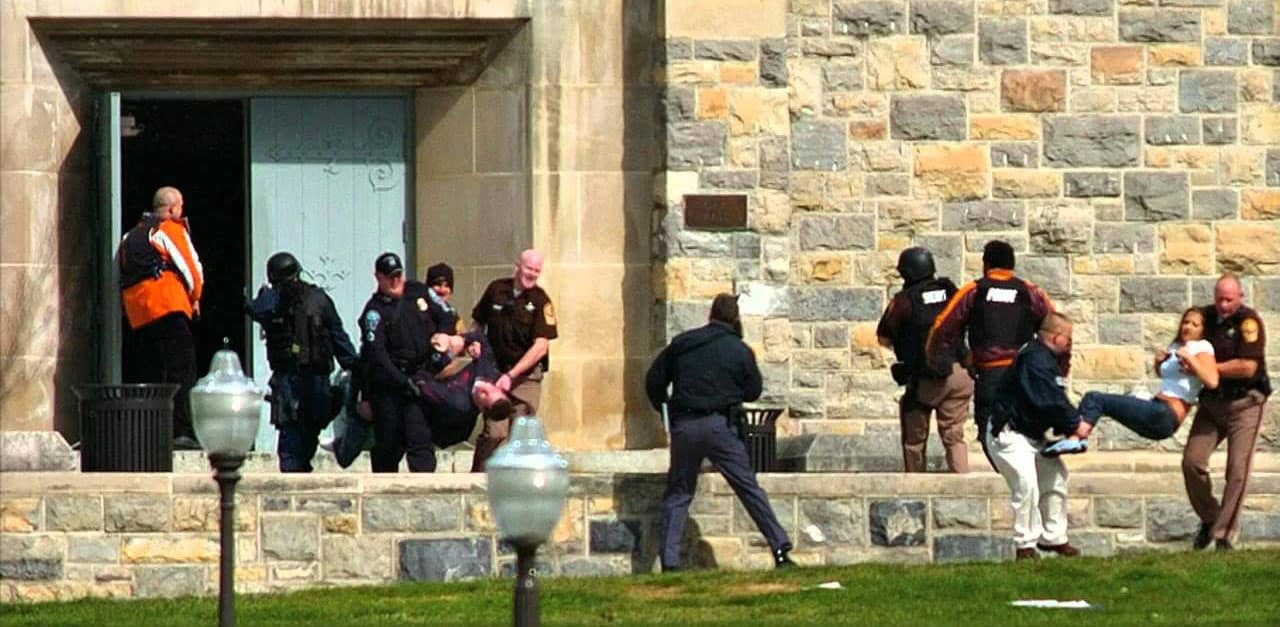
Law Enforcement officers carry wounded students out of Virginia Tech after a 2007 MCI shooting killing 32 and wounding 17 more

Evidence-based casualty care training designed for law enforcement officers operating in high-risk environments.

Law enforcement officers are often the first medical providers on scene in violent incidents. Knowing how to recognize life-threatening injuries and intervene decisively before EMS arrives saves lives — including your own.

What you'll learn

In this course, you will learn how to:
• Identify and treat the leading causes of preventable death in violent incidents
• Control massive hemorrhage quickly and effectively
• Make sound medical decisions under threat and time pressure
• Apply TECC and TCCC principles relevant to law enforcement operations
• Integrate casualty care with movement, cover, and team tactics

Did you know the best medical evidence is that tourniquets are only 70% effective on thighs?

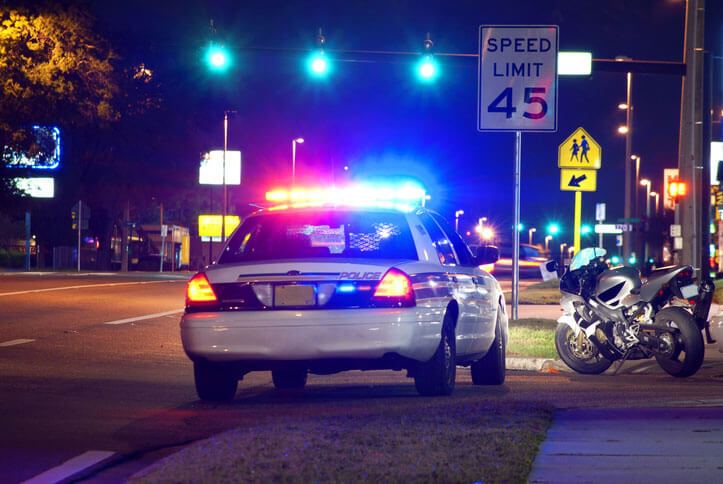
Police traffic stop at night with motorcycle pulled over

If you are a law enforcement officer, you will see someone who has been shot. It is the reality of your job. Do you have a realistic understanding of what your duty weapon does to an assailant? Do you have a realistic expectation of what the assailant’s weapon can do to you? This course will help you separate the scientific realities of gunshot wounds from fiction.  The FBI recommends a duty-load that penetrates 12-18 inches in ballistic gelatin. What’s the evidence behind those recommendations? How does ballistic gelatin compare to actual shootings?

In the aftermath of Sandy Hook, the Hartford Consensus recommended tactically relevant medical training for law enforcement, which was subsequently endorsed by the International Association of Chiefs of Police. As public access hemorrhage control kits become more widely available in public spaces, all First Responders should know what is in the kits and how to use them.

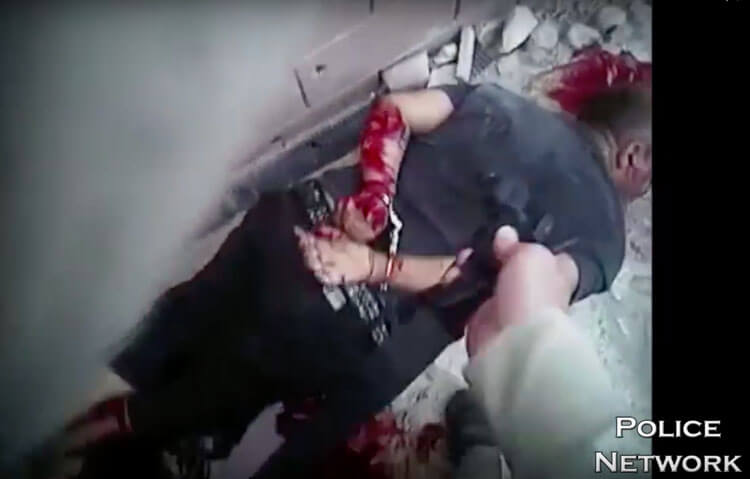
Las Vegas PD body cam footage shows officers saving a suspect's life by applying a tourniquet

The White House’s Stop the Bleed program teaches hemorrhage control. Bleeding is not the only cause of death in high-risk environments. Although typically in law enforcement, we think of high-risk incidents as active shooter events, (Boston 2013, bombing not shooting, not an active shooter event) high-risk environments can include many other sources including unstable buildings from explosion or fire, and natural disasters. Ultimately, a high-risk incident is one where you are as worried about your own safety as you are that of the casualty.

  • Where does casualty evaluation and management fall within your priorities during a high-risk incident?
  • How do you take care of a casualty in an on-going tactical situation?
  • How does your medical treatment of a victim change when they were injured in an explosion?

In a high-risk event, you will have to move casualties. Do you know how to do that safely and efficiently? This course will teach you the answers to all of these topics and more.

Course Format

This is professionally produced, online training designed for law enforcement schedules.

Courses are filmed and edited for clarity, with close-up skills demonstrations, diagrams, and photos of actual  injuries. You can train at your own pace, even on your MDT with blocks designed to be watched around calls, and focus on skills that translate directly to duty use.

The first time you see a critically wounded person should not be when you are trying to render aid to a citizen or your fellow officers. Expecting the Fire Department or EMS to be there to manage massive hemorrhage is naive. A casualty can bleed to death in less than five minutes from massive hemorrhage; average EMS times well exceeded that time frame. If you are not prepared to help, you will watch the casualty die.

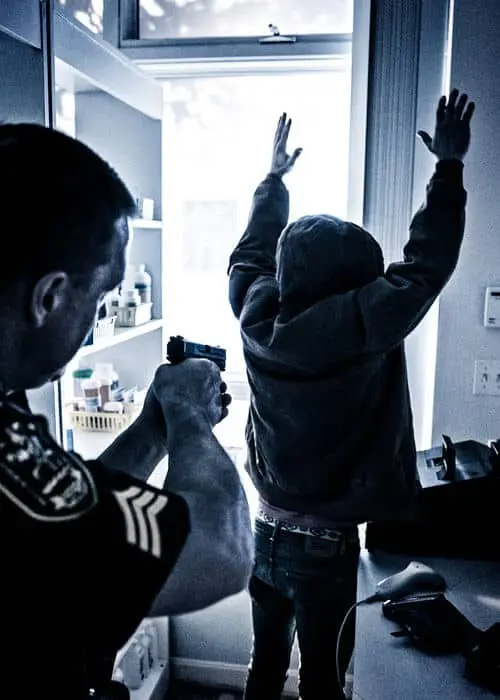
A suspect held at gunpoint by police after stealing prescriptions from a pharmacy. The police have their guns drawn on the suspect while the subject has his arms in the air.

You are required to be CPR certified. That’s great for the public. This course will teach you how to manage life-threatening wounds to yourself,  your partner, and the general public you are protecting. How much training did you have to take to get CPR or AED trained?  4 hours? More? How much tactical medical training have you had? Did your agency issue you a tourniquet supported by medical literature? Or did someone select the life-saving equipment based on cost or appearance?

Instructor: Mike Shertz, MD-18D

An Emergency Medicine physician can teach you the science. A former special-operations veteran can tell you what works. Mike Shertz, MD-18D can do both. With almost 20-years of law enforcement experience running a tactical medical program as an armed, embedded medic, Mike can integrate the medicine and tactics to apply them to the unique settings faced by law enforcement.

Tactical Casualty Care Class

TC2 course

The Tactical Casualty Care class requires no medical background or training. This material is the minimum level of medical tactical training anyone who carries a firearm, professionally or personally, should take. The 10.5-hour online course focuses primarily on the Care Under Fire or Direct Threat phase of an event, where the responder and injured are still in an ongoing threat to life. Learn how to quickly evaluate the injured, focus on what’s most important, manage massive hemorrhage, and stop preventable death with minimal equipment. This course teaches everything in the TCCC All Combatants Guidelines and the TECC First Responders With a Duty to Act guideline. 

CAPCE Accredited Provider:  This CE activity is accredited for 8 Basic CEH by Crisis Medicine, an organization accredited by the Commission on Accreditation for Prehospital Continuing Education.

The Advanced TC2 class was invaluable.


I’m glad this course was more than just learning about tourniquets for hemorrhage control.  Having the hands-on practice of wound packing, wrapping junctional wounds, and needle decompression on real models has given me a lot of confidence in my ability to address more than just bleeding out of arms and legs.

The online course including wound packing videos was very helpful and informative.  I think [our police] officers have a lot of comfort with tourniquets but because they’re only for arms and legs, and it was interesting to be given a possible solution for bleeding from other areas of the body where the tourniquet wouldn’t be appropriate.
Jaimie BeanPolice Sergeant
Beaverton, Oregon Police Department patch

...Exactly like training with Doc Shertz in person


I have known Doc Shertz since 2001. In nearly two decades of having received training from him, I have attended numerous courses he’s taught including his five-day in-person TCCC course. The training I just received in the on-line Advanced TC2 course is exactly like training with Doc Shertz in person. This includes everything from how he shares various stories to his sense of humor. If one can’t train with him in person, his online training through Crisis Medicine is the next best thing!
Overall, the video and sound production was very well done, including background colors, visuals, etc. This included various camera angles and a good balance between Doc Shertz talking and the PowerPoint presentation he was going over. At no point did it ever feel like a “death by PowerPoint.” The instructional format kept me interested the entire time.
Being in a reserve component of the military, I have completed countless required online training courses. I can honestly say Crisis Medicine's online course was the best I have ever done

Lee GilliamDetective
Gladstone Police Department

The course was excellent... Extremely interesting


The course was excellent.  It felt like I was sitting in Dr. Shertz's class during the lecture portions.  Dr. Shertz is an excellent presenter and trainer with a smooth delivery and the ability to give a lot of information in a way that keeps your attention.  You can tell that he is an expert in the field and that he is passionate about it.  I like that Dr. Shertz gives you more information than just "do this."  He gives background information and talks about how and why things are done.  He gives a lot of information from studies in order to support his statements and the interventions taught.  I found it extremely interesting.  

It isn't always practical to find a local class or to travel for training.  I think that is where these online courses come in.  Take one of these online courses and follow it up with practicing the physical skills shown in the course.  Any first responder, gun owner, parent, hunter, etc should know this stuff.  Do the training before you need it.  
Jason TillotsonPolice Officer
Jason Tillotson

As a police officer my sole duty is to protect and save lives, this course will hopefully allow me to do that better.


I was fortunate enough to take the online Complete course after taking the TC2, which I thoroughly enjoyed. As a police officer, and current EMS student, I wanted to learn and see more of how I could help in the field.

Honestly, I believe I learned more from Dr. Shertz in his courses, than I did an entire 18 week EMS course for Basic EMT. Not only did he address the basics, but he covered skills that directly translate into the real world in a way that is easy to follow.

It's easy to see Dr. Shertz is a stand up gentleman, aside from his well spoken lectures and sly humor, he cares for the education of others. I certainly hope I can pay it forward some day with the skills I learned from him.
Ken PadonePolice Officer
Ken Padone

I'd give the course 5,000 stars...


This course is outstanding. Mike is a phenomenal instructor. He keeps you engaged and has set the course up to it is easy to follow. Whether you are new to first aid or a doctor, I promise you will find the course informative and entertaining. I love that his experience and training is reflected in the course as well. It is also great that he backs up everything with medical literature and research, and when he disagrees or has an opinion he clearly tells you it is his opinion and supports it with rational and solid reasoning. He is also quite witty and funny at times. Cannot wait to take the next course!
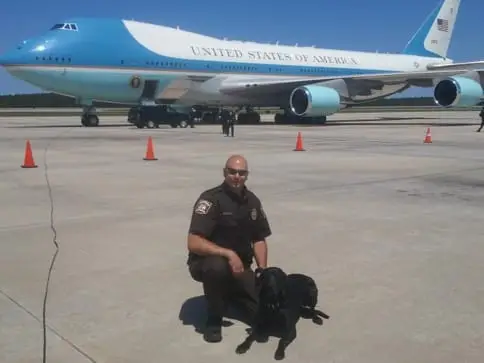
Brad KirbyLaw Enforcement Officer & K9 Handler
Brad Kirby
Start Training Now

Featured Courses

Tactical Casualty Care – ONLINE

Tactical Casualty Care – ONLINE

$150.00
Advanced TC2 – ONLINE

Advanced TC2 – ONLINE

$395.00
Complete TC2  -ONLINE

Complete TC2 -ONLINE

$595.00
Improvised TECC/TCCC

Improvised TECC/TCCC

$125.00
K9 Tactical Casualty Care for Humans  – ONLINE

K9 Tactical Casualty Care for Humans – ONLINE

$75.00
Tactical CBRN Casualty Care – ONLINE

Tactical CBRN Casualty Care – ONLINE

$225.00
First Receivers – No Notice MCI Events – ONLINE

First Receivers – No Notice MCI Events – ONLINE

$175.00
Air Travel Emergencies – ONLINE

Air Travel Emergencies – ONLINE

$175.00
Sign up for updates
Our privacy policy can be found at https://www.crisis-medicine.com/privacy-policy/
Loading

DUNS: 093140133

CAGE: 8U3A3

  • About Us
  • Disclosures – None
  • Contributors
  • Contact
  • About Us
  • Disclosures – None
  • Contributors
  • Contact
  • In-Person Training
  • Content Warning
  • In-Person Training
  • Content Warning
  • Terms
  • Privacy Policy
  • Scope of Practice
  • FAQs
  • Terms
  • Privacy Policy
  • Scope of Practice
  • FAQs
  • N. Amer. Rescue
  • TacMed Solutions
  • Chinook Medical
  • Skedco
  • Wound Cube
  • N. Amer. Rescue
  • TacMed Solutions
  • Chinook Medical
  • Skedco
  • Wound Cube
©2026 Crisis Medicine all rights reserved.
  • Privacy
  • Terms
  • Sitemap
  • Privacy
  • Terms
  • Sitemap

Login with your site account

Lost your password?