
In war wounds, nosocomial (hospital-acquired) infections are common. This occurs due to initial high wound contamination, extensive devitalized tissue in the wound, multiple surgical interventions, prolonged hospitalizations, and extensive use of early broad-spectrum antibiotics.1
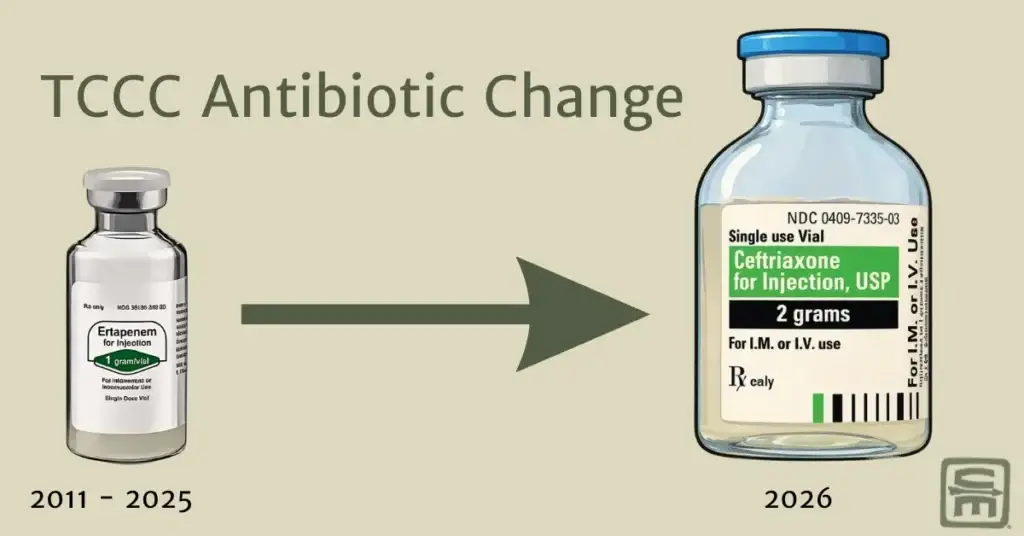
In late 2025, Co-TCCC changed their recommendations for parenteral antibiotics in the TCCC Guidelines from 1 gm IV IO IM ertapenem once a day to 2 gm IV IO IM ceftriaxone once a day.2
This change was made based on research showing point of wounding bacterial exposure is generally group A strep, methicillin-sensitive Staph aureus, and clostridium perfringens. This is further supported by microorganism data from war wounds cultured in a median of 7 hours post-wounding in casualties on the Ukrainian front line (well before reaching any medical treatment facility). Other cultured bacteria from that study were generally skin flora and of low significance.3
Organisms like Acinetobacter baumannii, common during the GWOT, are generally hospital-acquired, and there has been concern that the increased presence and drug resistance of that organism were due to the TCCC’s use of ertapenem. There are now very resistant strains of A baumannii that are difficult to treat. In a recent dataset from Ukraine 2025, 91% of identified A baumannii were resistant to carbapenem (ertapenem / meropenem) antibiotics. That organism represented 17.4% of all bacteria identified in their wounds. In the Ukrainian point of wounding data set above, despite culturing 100 casualties, it was found in only one.3
Ceftriaxone provides appropriately broad coverage for point of wounding bacteria, while also maintaining antibiotic stewardship with a goal of reducing antibiotic-resistant infections.
Resistance of bacteria to antibiotics and disinfectants first began around WWII with the use of sulfonamide and penicillin antibiotics and ammonia as a disinfectant. Additionally, armed conflict drives resistance secondary to a breakdown in sanitation and to mass migration / evacuation to new geographic areas.4
A systematic review of 22 studies involving patients injured in Iraq and Afghanistan showed the rate of multidrug-resistant organisms to be 86%. It was felt the majority of A. baumannii infections were acquired in military hospitals.5 Similarly, concerning rates have been seen in Ukraine since 2014.4
Ceftriaxone is generally reconstituted with 10 ml normal saline per gram of drug and swirled until the drug dissolves. 2-gram vials of ceftriaxone are commercially available. Many are only 15 ml sized, indicating that less normal saline volume can be used for reconstitution of the drug.
Ceftriaxone will precipitate if mixed or administered with calcium-containing solutions such as lactated ringers or through an inadequately flushed IV line that was previously used to administer calcium or calcium-containing solutions. However, the same IV can be used for ceftriaxone and calcium-containing solutions if the line has been “thoroughly flushed” before or between substances.
There dosen’t seem to be any concensus between ED nurses regading exactly how much flush this is, but most agree at least 10 to 20 mls.
Ceftriaxone is administered over 3 to 5 minutes IV / IO push. This rate is similar to ertapenem.
For IM ceftriaxone, FDA drug labelling recommends a minimum of 2.1 ml of diluent per 1 gm drug. Therefore, for 2-gram IM administration, you would need 4.2 ml normal saline. This is pushing the generally agreed upon volume limit for IM injections of 5 ml. In the emergency department, IM ceftriaxone is often diluted in 1% lidocaine to minimize the pain associated with this large volume injection. IM ceftriaxone should always be injected into a large muscle, such as the lateral thigh.
Although ceftriaxone is completely absorbed when given IM, it is much slower, taking 2 to 3 hours to reach the maximum mean plasma concentration in normotensive patients. In hypotensive casualties, decreased blood flow to muscle will further slow drug absorption.
On the contrary, IV / IO administration achieves maximum mean plasma concentration in 30 minutes, which is why IV / IO administration is always preferred in significantly wounded casualties. Simply put, the drug gets in and starts working faster.
1Noble Slave, Analysis of Antimicrobial Resistance of Microorganisms, Isolated from War Wounded Patients (Q2 2025), Military Medicine in the Armed Forces of Ukraine, Medical Forces and Sustainment Group “East,” 2025
2Wisniewski P, Becker YA, Larson DT, Blaylock JM, Butler FK Jr, Cybulski RJ, Deaton TG, Donovan KA, Graf PCF, King JR, Lewandowski LR, Maves R, Neading R, O’Shea MK, Ressner RA, Wallace JD, Weymouth WL, Murray CK. Antibiotics in Tactical Combat Casualty Care 2025: TCCC Change 25-1. J Spec Oper Med. 2025 Dec 1;25(4):85-93. doi: 10.55460/SW7X-X8ZP. PMID: 41474877.
3Dumchev K, Mc Gann P, Danyliuk O, Metreveli M, Musich TA, Bennett JW. Microbial Flora in War Wounds from the Ukrainian Front Line. N Engl J Med. 2026 Feb 26;394(9):926-928. doi: 10.1056/NEJMc2512101. PMID: 41740038.
4Costescu Strachinaru DI, Ragot C, Stoefs A, Donat N, François PM, Vanbrabant P, Verroken A, Janvier F, Soentjens P. Management and Prevention of Multidrug-Resistant Bacteria in War Casualties. Trop Med Infect Dis. 2025 May 8;10(5):128. doi: 10.3390/tropicalmed10050128. PMID: 40423358; PMCID: PMC12116051.
5Granata G, Petersen E, Capone A, Donati D, Andriolo B, Gross M, Cicalini S, Petrosillo N. The impact of armed conflict on the development and global spread of antibiotic resistance: a systematic review. Clin Microbiol Infect. 2024 Jul;30(7):858-865. doi: 10.1016/j.cmi.2024.03.029. Epub 2024 Mar 29. PMID: 38556213.