Improvised Pant-leg Pelvic Binder

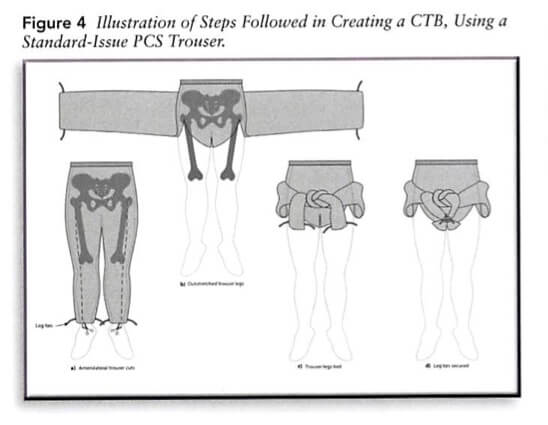
a diagram showing the four steps in an improvised pant leg pelvic binder

Pelvic fractures occur in 8% of major trauma patients. You can improvise a pelvic binder.

🕖 Reading Time, 3 minutes

IED induced injuries resulting in traumatic lower limb amputation are associated with a 22% rate of pelvic fracture; half of which are unstable ring fractures.  Death from pelvic fracture largely occurs from venous bleeding inside the pelvis.


Having your management plan fall apart because you have no commercial devices is weak.

Commercial Pelvic Binders

Although the literature on the effectiveness of commercial pelvic binders is variable and there is no clear data showing they improve survival, decreasing bleeding is always a good idea.

Purpose-built commercial devices are almost always preferred over improvised techniques. However, having your management plan fall apart because you have no commercial devices is weak.

Improvising a Pelvic Binder

Using a technique very similar to our improvised pant leg tourniquet, Loftus and colleges recently compared an improvised pelvis binder made from the casualty’s pants to a commercial TPOD pelvic binder in an unstable pelvic fracture model.  Measuring the intrapelvic pressure in six unembalmed cadavers, they found the improvised technique resulted in similar mean and median pressures compared to the TPOD. Although not necessarily robust evidence of effectiveness, it is proof of concept.

A cartoon diagram of using a casualty's pantalets as an improvised pelvic binder.
Diagram from JSOM Vol 17, 3rd Ed, page 37.

We suspect the effectiveness of this technique may vary depending on the material used in the casualty’s pants.  The study used British combat trousers, which are 100% cotton. Just another reason wearing spandex pants is not combat effective.

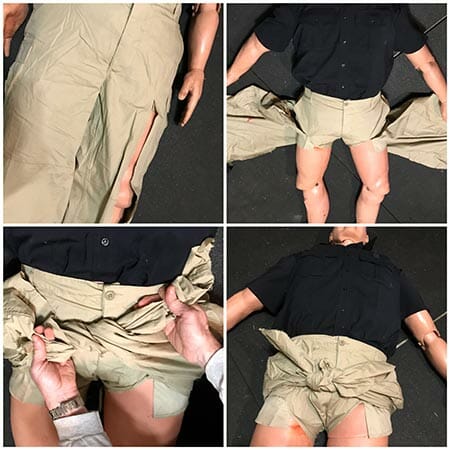
To use this technique, cut the pantleg trouser superiorly to the greater trochanters, lay out the pant legs like wings, wrap them tightly around the pelvis, tie with a square knot. See photos above.

This technique is convenient because it requires no additional supplies, however it has not been shown to be the most effective improvised pelvic binder.

For a current literature review on improvised pelvic binders, you’ll want to check out our Improvised TECC/TCCC class, which discusses improvised techniques based on medical literature.

References

Picture of Mike Shertz MD/18D

Mike Shertz MD/18D

Dr. Mike Shertz is the Owner and Lead Instructor at Crisis Medicine. Dr. Shertz is a dual-boarded Emergency Medicine and EMS physician, having spent over 30 years gaining the experience and insight to create and provide his comprehensive, science-informed, training to better prepare everyday citizens, law enforcement, EMS, and the military to manage casualties and wounded in high-risk environments. Drawing on his prior experience as an Army Special Forces medic (18D), two decades as an armed, embedded tactical medic on a regional SWAT team, and as a Fire Service and EMS medical director. Using a combination of current and historical events, Dr. Shertz’s lectures include relevant, illustrative photos, as well as hands-on demonstrations to demystify the how, why, when to use each emergency medical procedure you need to become a Force Multiplier for Good.