
🕖 Reading Time, 12 minutes
Researched and written by Mike Shertz, MD/18D, not AI
How long can a human survive adrift at sea in an inflatable life raft? In 1982, sailor Stephen Callahan answered that question first hand. After his small sloop capsized in the Atlantic, he spent 76 days alone in an inflatable life raft, wearing only a T-shirt and a watch. What followed was a triumph of grit, optimism, and decision-making under deprivation.
Callahan had a life raft, survival materials, and prior preparation—nearly every assumption built into modern inflatable life raft design and water-rationing guidance was tested, stressed, and ultimately proven.
From dehydration math that doesn’t pencil out, to inflation systems that demand constant labor, to signaling equipment that fails despite an audience, his experience exposes the narrow margin between survival and slow failure.
This is not an adventure story. It’s a case study.
Life Rafts Don’t Save You—Decisions Do: Lessons from 76 Days Adrift
In 1982, Stephen Callahan spent 76 days lost at sea in a standard Avon inflatable six-person life raft after his small sloop capsized while crossing the Atlantic Ocean alone in a race.
Just before midnight, he lay down to rest wearing a T-shirt and a watch. Shortly thereafter, he was forced to abandon his ship as it sank. That is all he would wear for the next 2 1/2 months.
Callahan planned ahead and obtained an inflatable life raft, as is typically required. Still tethered to his sinking ship, he waited before cutting the painter / mooring line connecting the two. This life raft was a smaller version of those found on commercial airlines. Realizing his sloop was sinking more slowly than he initially thought, he re-boarded to obtain more supplies. He thought: “Wait and salvage everything you can.”
Commercial airline life raft painter’s/mooring/inflation lines are required by the FAA to break at 500 pounds of tension to eliminate the chance that the sinking aircraft could pull down the life raft, even if the line isn’t cut, freeing the life raft from the sinking aircraft. There is also a requirement for a hook knife to be mounted near the line’s connection to the life raft.
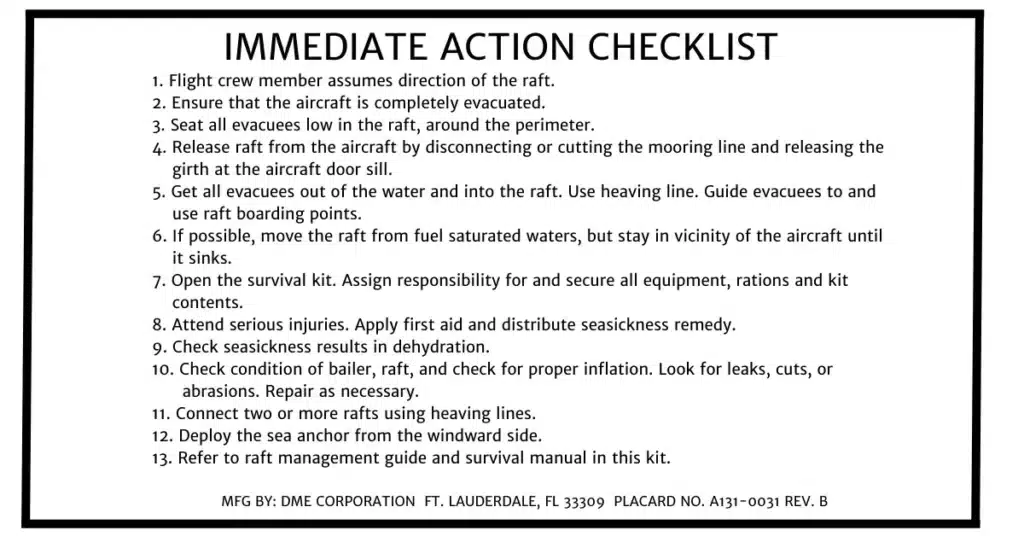
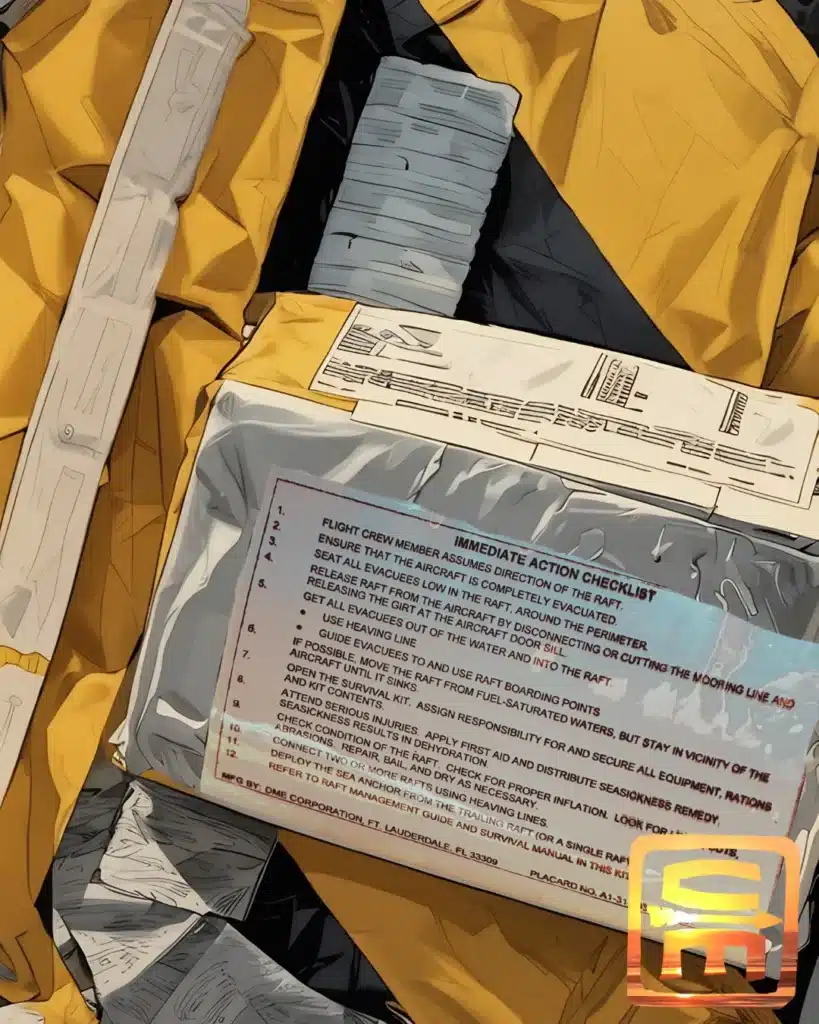
These life rafts contain “survival kits.” To supplement resources on the life raft, he began “hacking off a piece of the main sailcloth, careful not to cut his raft.” He also re-entered his sloop and dove down to a lower compartment, now filled with water, to free a pre-staged “emergency bag.” Although the bag was waterlogged, he eventually retrieved it.
On the way back to his life raft, he grabbed items floating by, including: a cabbage, a Tupperware box containing a few eggs, a seat cushion, and an empty coffee can. Eventually, he also recovered his sleeping bag.

Once freed from his sinking craft and safely on the inflated life raft, he began the process of bailing the water out that accumulated when it inflated. The coffee can came in handy for this process. Throughout his 76 days at sea, he periodically had to re-bail, depending on sea swells and the weather. It took three days to get fully dry every time he had to redry the raft and himself.
Callahan quickly realized his skin had developed saltwater wounds from being constantly wet. Gouges and abrasions became infected, all of which were made worse by the wet / damp raft.
Commercial life raft survival kits consistently contain a collapsible bailing bucket. Dried sponges are also common items in life raft survival kits, both to help dry the raft interior and to aid in dew/rainwater collection off the life raft canopy, which is FAA required to not be coated in anything that would interfere with drinking any water collected off it.
By day 17, Callahan found that his canopy coating had broken down and that small orange particles had formed in the collected rainwater. He described trying to drink this water like “forcing down another man’s vomit.” By day 52, the canopy was as rain-resistant as a T-shirt.
This 6-person raft has a 5‘6“ inside diameter. When he was preparing for his race, his sloop was inspected by the race committee, and they were surprised to find he had such a large survival raft for one person. He asked them if they had ever spent any time in a four-man raft? He had, with two other individuals, which made him realize you need a bigger life raft; they were “literally on top of each other with their knees overlapping.” He felt survival in that setting for more than a few days would be questionable and, at best, torturous.
FAA life raft size requirements are 3.6 square feet per passenger, but can be decreased to 2.4 square feet each if the life raft is overloaded to 50%. This means a 46-passenger life raft can be overloaded to 69 passengers per FAA if needed.
Unfortunately, even with this larger life raft, the only spot where he could sit, fully upright, was in the center of the raft. Anywhere else, his head pushed into the canopy, forcing him to slouch down. In heavily loaded commercial airline life rafts, everyone is meant to kneel or sit. Any movement in the raft is intended to be by crawling “on hands and knees” per the 747-management guide for slide rafts.
Callahan found the life raft floor was “thin rubber“ and rippled and rolled as if it were a water bag being “jumped upon by two sizable kangaroos.” Throughout his 76 days adrift, large fish and sharks would “bump“ the floor of the raft frequently.
The life raft was equipped with an emergency position-indicating radio beacon, which transmitted a signal on two frequencies typically monitored by commercial aircraft. Unfortunately, he was never able to contact anyone. He left the emergency transponder on for the first 30 hours, hoping that someone would hear it in the first 24 hours and then have six additional hours for aircraft to search and find them.
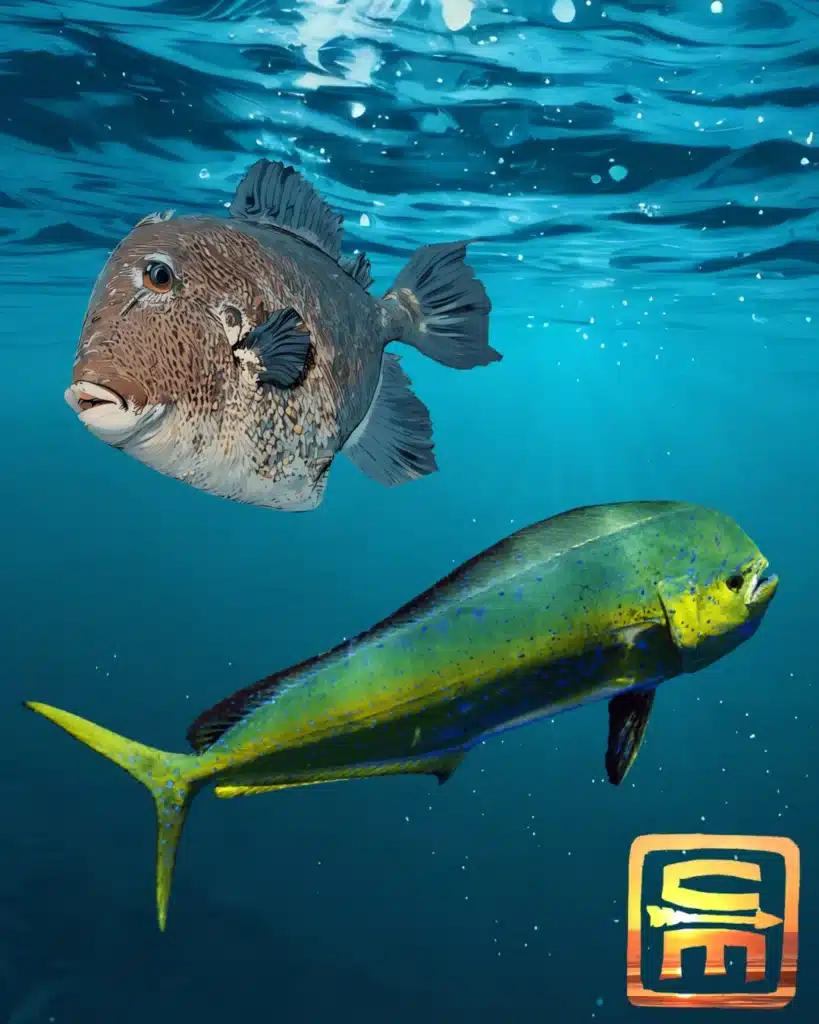
Because he salvaged a spear gun before his sloop sank, he began fishing for Dorado and triggerfish. Eventually, he came upon a scheme that allowed him reasonable success, and he was able to catch fish. As with all fishing, it sometimes took hours of failure before success.
He knew very well from prior research in only one case had anyone survived longer than 40 days in an inflatable raft. Callahan still holds one of the longest records.
He became acutely aware that, despite the fully inflated life raft, it required frequent re-inflation. The raft slowly leaked air from a pressure relief valve. In the sun, the black life raft’s side tubes would heat up and release excessive pressure. That meant when the temperature got colder, it needed to be “topped off.” There was a small “foot pump” to reinflate the tubes, but he found it an odd design, since there was no way to stand on it to use it. Subsequently, he squeezed it between his hands. Early on, he pumped up the raft four times a day. Some days required only 60 pumps; eventually, as the raft developed holes, it required over 300 pumps a day to maintain inflation.
FAA requirements include a manual inflation pump, as this inflation / deflation sequence based on environmental temperatures alone is expected.
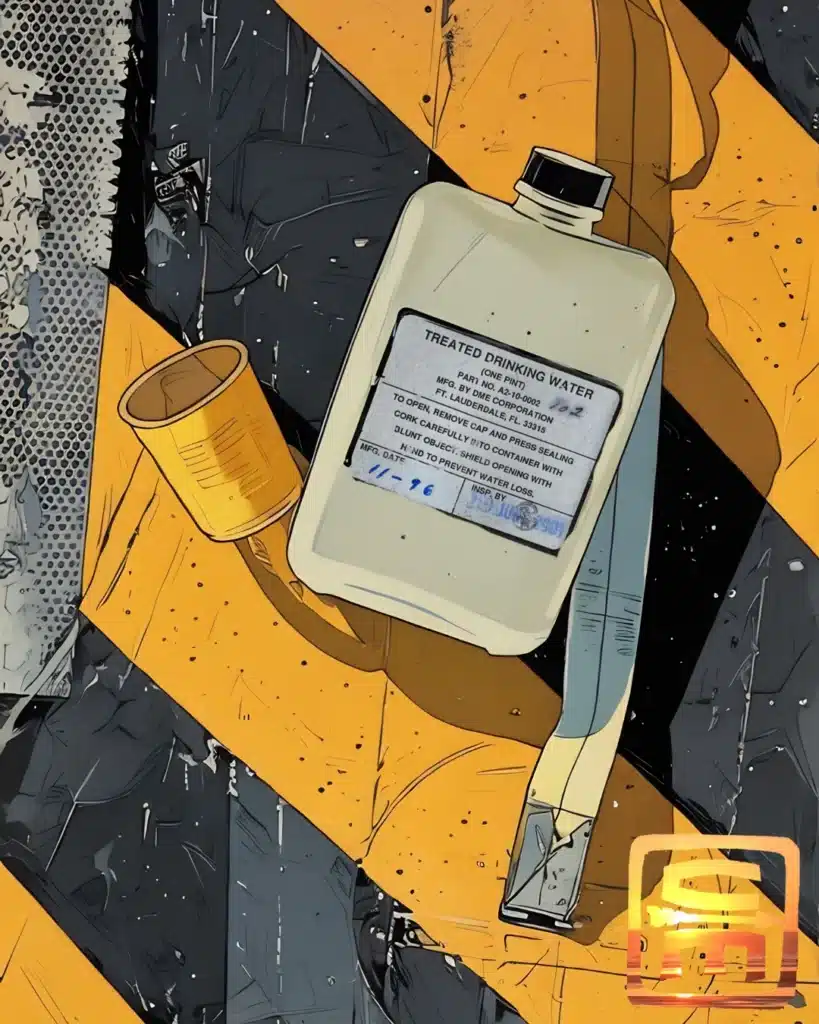
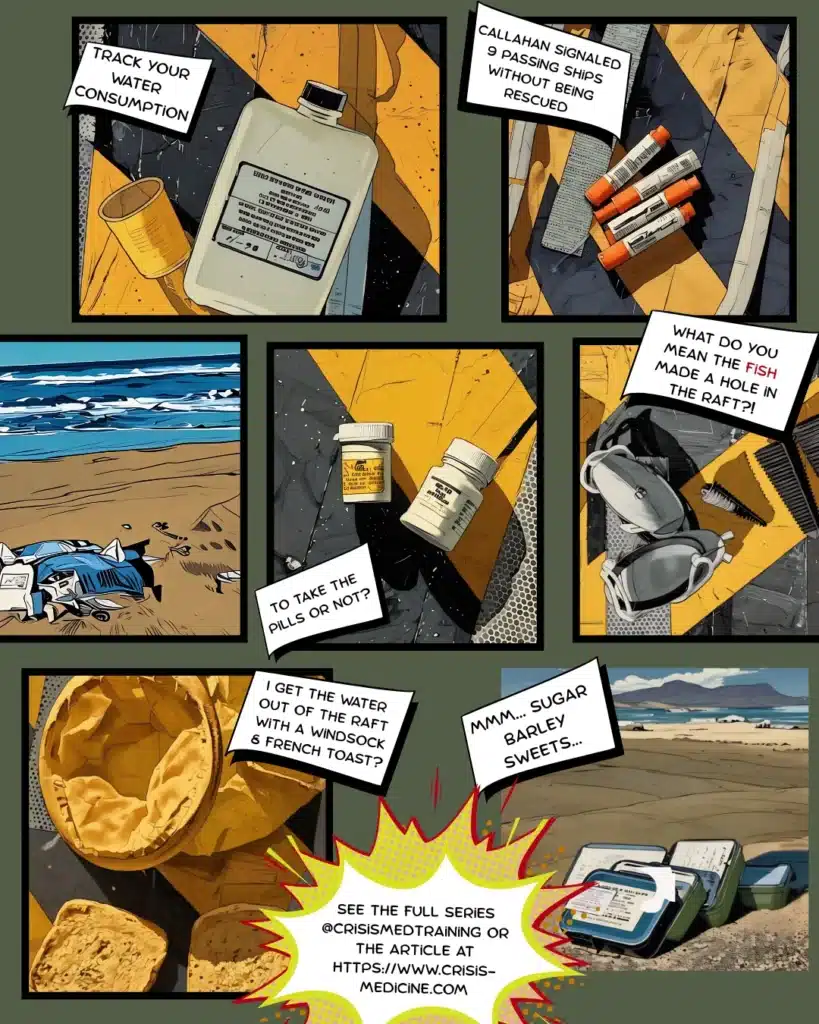
Callahan marked a clear plastic water jug and decided to ration himself to half a pint of water per day. To do this, he took a mouthful every six hours.
Prior to his trans-Atlantic race, Callahan had added two surplus “solar stills” to his life raft. He was able to produce fresh water, but with great difficulty and constant maintenance. Early in his drifting, he rationed himself to 8 ounces of water each day. When the solar stills worked, and he collected rainwater, he drank about 20 ounces a day.
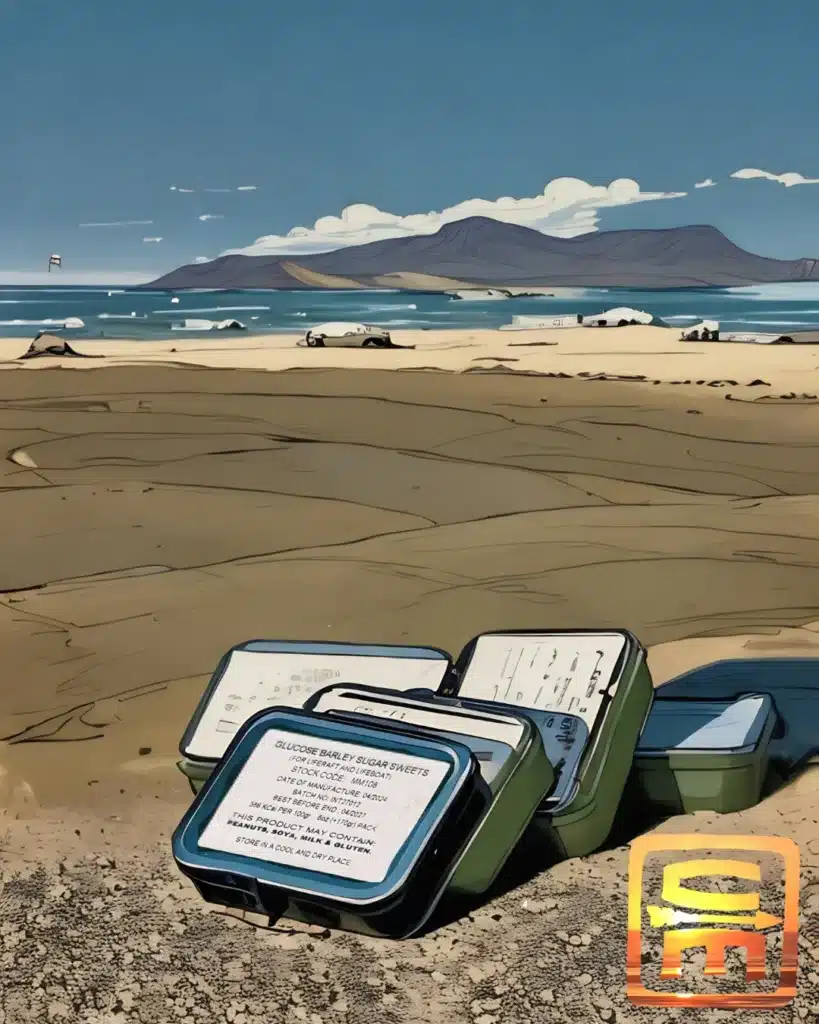

The quantity of drinking water in a commercial aircraft life raft survival kit can vary widely, but it is always minimal. Provided water packets are specifically labelled “drink no water in the first 24 hours, unless sick or injured.” Additional instructions specify to drink 8 ounces of water a day thereafter. Elsewhere, survival instructions say not to drink until maximally thirsty. An adult can’t survive on this quantity of water, but it can prolong your death.
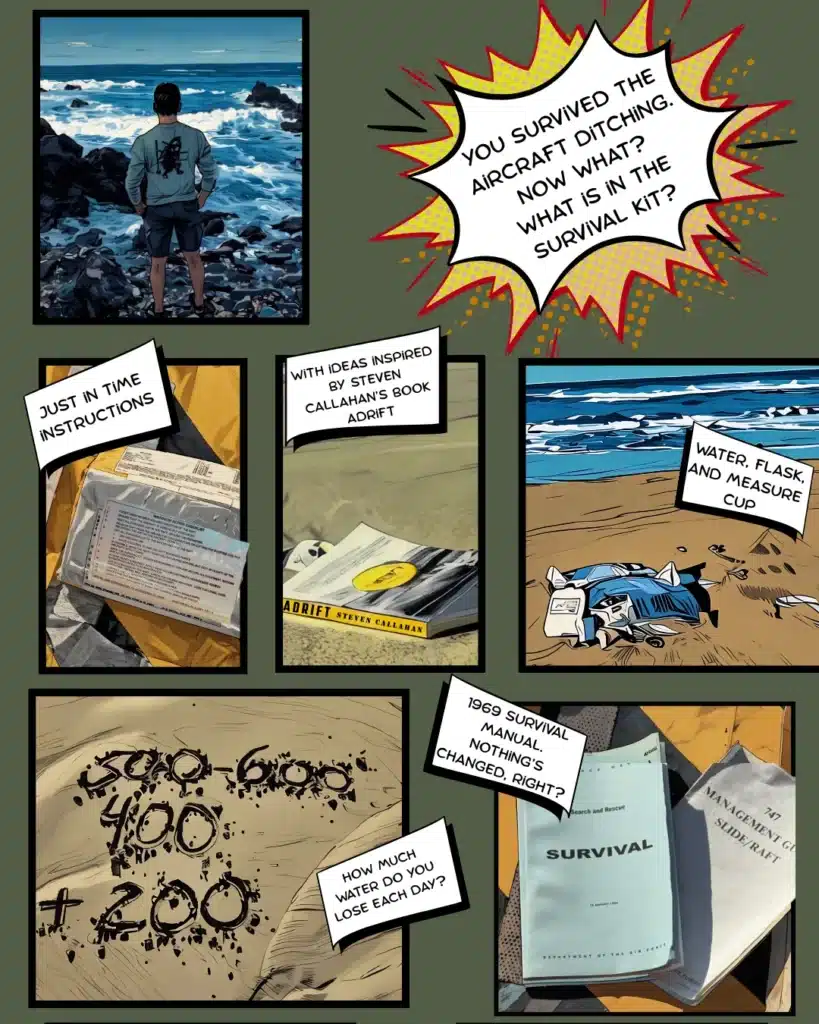
The minimum amount of water a person needs to survive varies substantially based on their body weight, environmental conditions, and diet. A certain amount of water is “wasted” from the body regardless of hydration status. Based on the kidneys’ concentrating capacity, 500 to 600 ml of urine is the obligatory minimum daily flow for someone on a low-sodium diet. An additional approximately 400 ml of water leaves the skin by diffusion, even in “comfortable climates.” Much more can be lost in hot environments. Finally, about 200 ml of water is lost from moisture in breath. This can also be significantly more in cold, dry air.
Based on this, the absolute minimum volume of water a person needs to survive would be about 1.2 liters per day. In the words of Claude Piantadosi, “this value is not particularly realistic, because it means one cannot sweat a drop, exercise a wit, or have a loose bowel movement without risking dehydration.” The Biology of Human Survival: Life and Death in Extreme Environments.
Since thirst is not generally activated until one’s blood osmolality has increased and their blood volume decreased, for a 70 kg (154 lbs) person, thirst won’t consistently occur until they have lost over 2 liters of body water. By telling life raft passengers not to drink water until maximally thirsty, this results in uniform dehydration across all on board.
It is estimated that a 12% loss of body mass will cause clinically apparent shock. Again, using the 70 kg person example, this would occur once they have lost 8.4 liters of fluid or 20% of their total body water. Based on the above, with a minimum water loss from the body of 1.2 liters per day in ideal conditions, the same 70 kg person could survive for one week with no additional water intake.
Ultimately, Callahan made a rain catch from a Mylar space blanket he had in his kit. He was able to retrieve some water from the canopy. Over time, the canopy broke down, and parts of the coating flaked off, contaminating his water.
Consuming high protein foods without additional water speeds up dehydration. Sugar and carbohydrates are metabolically converted to CO2 and H20 as they are digested. A high carbohydrate diet in a survival situation actually contributes about 300 ml of water to your system each day. The UK Royal Navy has used glucose barley sugar, turned into cough-drop sized lozenges, which contain 96% carbohydrate as the survival ration in their lifeboats since WWII. These provide 396 calories per 100 grams. Many commercial airline life raft manufacturers also include these.

Fairly early on, he discovered two small holes in the floor of the life raft. There was a patching kit that included glue and pieces of raft material. However, the instructions said you had to dry the area first, which, while stranded at sea, he found to be a great joke. It took three attempts and two hours of work using tape, Band-Aids, and a lighter to eventually get a patch to stick. With that, he slowly began to dry out.
Eventually, while struggling with a speared fish, his life raft’s side tube was punctured. Callahan’s life raft did stay afloat with a partially deflated side tube, but was subjected to significant overflowing seawater until he was able to repair the flaccid tube.
FAA requirements are that the life raft be dual-side-tubed and maintain buoyancy with only one tube inflated at overload capacity.
The hole in his life raft’s side tube was too large for the conical repair tubes included in the life raft survival kit. He struggled with various improvised patches for days at a time, only to have them fail, which forced him to try another approach. Eventually, after an eight-day struggle, he found a lasting solution. Later, he suffered another hole in the life raft floor from another fishing / spearing incident. This one was so small he had to enlarge it to fit one of the smallest conical plugs, which he found did work well. He reinforced the rubber screw plug by wrapping some fishing line around it.
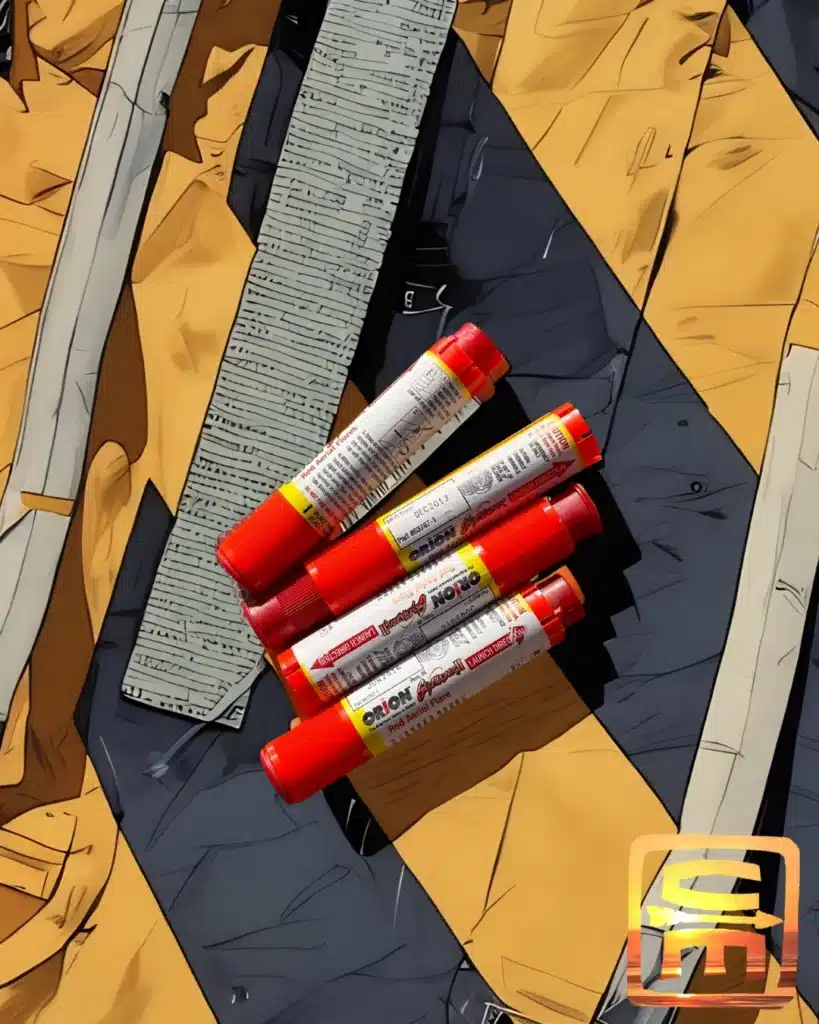
During his 76 days adrift, he was passed by nine ships. Despite a large quantity of hand and parachute flares, he was never able to be seen by them. The FAA requires “at least one pyrotechnic signaling device.” Most life rafts have several, as well as a non-pyrotechnic option, such as a signal mirror.
Callahan improvised navigation to try to determine how close to shipping lanes he was. He constructed a makeshift sextant from pencils and rubber bands, and using the North Star as a guide, he estimated his position and direction toward the Caribbean
Ultimately, Callahan drifted across the Atlantic Ocean to off the coast of Marie Galante, a tiny island in the Caribbean, where he was found by fisherman and finally rescued.
It is unknown if he began drinking tiki cocktails as a result of his ordeal, but the island is currently known for artisan rum distilleries.
This post was inspired by reading Adrift: Seventy-six Days Lost at Sea by Stephen Callahan. You can easily find a copy at your favorite bookseller, and should not be confused with the 2018 movie of the same title, which is not based on Callahan’s experience. Published 2002
The Biology of Human Survival: Life and Death in Extreme Environments, Claude A. Piantadosi, 2003.
Check out our social media reels on these topics, shot on location on a desolate beach on a South Pacific island… (or Hawaii, use your imagination).