
Actual casualty data from Ukraine is sparsely published. Whether that’s because they want to limit its propaganda value, because the medical providers are already overworked saving lives, or simply because active war zones are difficult to collect detailed data in is unclear.
Researched and written by Mike Shertz, MD/18D, not AI
🕖 Reading Time, 8 minutes
As I have said before, when passing along information from Noble Slave – Military Medicine in the Armed Forces of Ukraine posts, it would be great if we knew more about their data set, for example, how the data was collected, how many casualties, in what settings, etc. Academically, it would be even better if their data was published in a peer-reviewed journal to allow for editorial review. But they are at war.
All that being said as an Emergency Physician, the SF medic in me still finds anecdotal experience operationally useful, as long as you maintain the perspective that it is someone’s experience, not specifically hard science. Until rigorous published data is widely available, we will have to take what we can get.
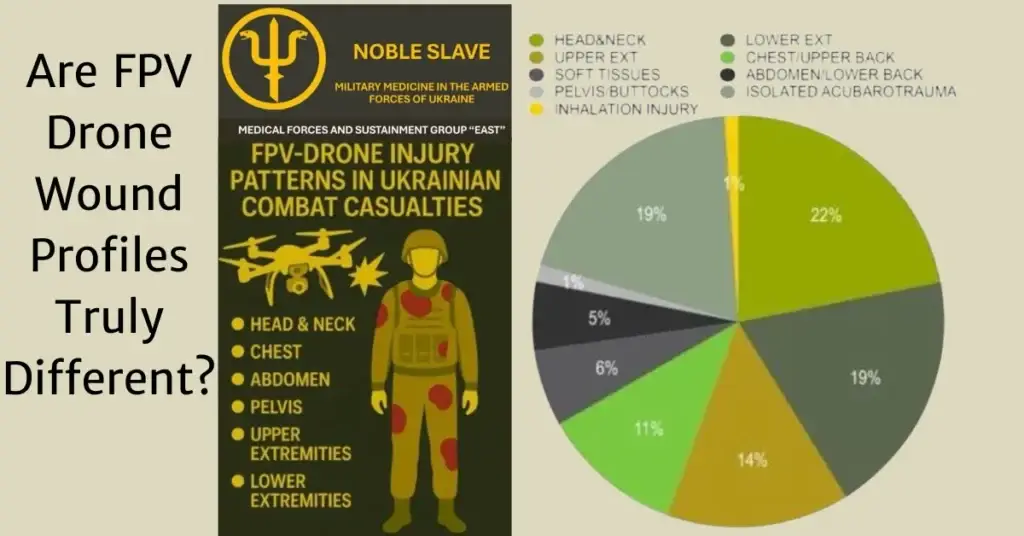
Noble Slave – Military Medicine in the Armed Forces of Ukraine posted their experience with casualties from first-person view (FPV) drone attacks between January and September 2024.
Although prior peer-reviewed, published medical literature on drone casualties exists, it was from Israeli drones used in Gaza between 2006 and 2016. At that time, drone strikes were the most common cause of limb amputation in Gaza.1,4 However, those drones were vastly different than the current generation of first-person view drone attacks in Ukraine.
Of the FPV drone casualties arriving alive to their facility,
Interestingly, 3.4% of their drone-injured had some toxic exposure, generally felt to be chloropicrin from Russian K-51 grenades. (For a more detailed review of chloropicrin, see link here.)
Traditionally, the greatest wounder on the battlefield is indirect fire. It is easier to drop huge quantities of munitions on the heads of the enemy than it is to put a front sight on them and get a hit. This is demonstrated by the 50% cause of injury from mortars, rockets, and artillery in the Pacific Bougainville campaign (WWII) versus 22% during Vietnam.3
During WWII, based on a dataset of over 116,000 casualties,3 25% of the injured had wounds to their head and neck. This decreased to 15% during Vietnam, correlating with the decreased use of rocket / artillery and general lack of air-dropped munitions from the Vietcong and North Vietnamese army, though we can’t say that definitely caused the reduction. The FPV drone rate of 22% head / neck injuries is consistent and expected for air-dropped munitions.
Extremity injury rates were largely the same at 53% during WWII and 55% in Vietnam. Those aren’t surprising numbers, since about 61% of an adult’s body surface area is on the extremities. It is interesting the current FPV drone casualties’ extremities are under-wounded based on statistical chance alone.
What does all this mean? FPV drone attacks are a unique, not previously seen mechanism of ordnance delivery. However, are the wound profiles of FPV drone attacks really different from other air-dropped munitions?
Maybe, but we need better data.
1 Heszlein-Lossius H, Al-Borno Y, Shaqqoura S, Skaik N, Giil LM, Gilbert MF. Traumatic amputations caused by drone attacks in the local population in Gaza: a retrospective cross-sectional study. Lancet Planet Health. 2019 Jan;3(1):e40-e47. doi: 10.1016/S2542-5196(18)30265-1. PMID: 30654867.
2 Nato War Surgery 2018
3 Carey ME. Learning from traditional combat mortality and morbidity data used in the evaluation of combat medical care. Mil Med. 1987 Jan;152(1):6-13. PMID: 3103012.
4Heszlein-Lossius H, Al-Borno Y, Shaqoura S, Skaik N, Giil LM, Gilbert M. Severe extremity amputations in surviving Palestinian civilians caused by explosives fired from drones during the Gaza War. Lancet. 2018 Feb 21;391 Suppl 2:S15. doi: 10.1016/S0140-6736(18)30381-7. Epub 2018 Feb 21. PMID: 29553412.
5 Xydakis MS, Bebarta VS, Harrison CD, Conner JC, Grant GA, Robbins AS. Tympanic-membrane perforation as a marker of concussive brain injury in Iraq. N Engl J Med. 2007 Aug 23;357(8):830-1. doi: 10.1056/NEJMc076071. PMID: 1771542