OUR SCHOOL LEADERSHIP TEAM LEARNED CRUCIAL SKILLS IN A CLEAR AND ACCESSIBLE MANNER
As a school administrator with student safety as my top priority, I felt compelled to do something to prepare for the worst. Mike's course taught our leadership team crucial skills in a clear, hands-on, rational, and accessible manner. Mike's approach delivers Stress Inoculation for the learners, which I deeply valued. The topics are intense and real. Thinking through scenarios in advance can only serve us better in a real crisis. My team feels prepared, calm, and knowledgeable after spending the time in this course. I strongly believe that this approach to community health is one that any school should pursue. The learned skills are as good for a crisis as they are for a serious playground injury.Thanks much Crisis Medicine and please keep up the good work.
I FEEL MORE CONFIDENT IN HELPING IN A BAD SITUATION
I took the Essential Casualty Care class and felt like I got so much out of that short course. It was definitely worth the $35. You really took away the confusion I previously had on what to include in a trauma kit and how to actually USE those items - which I know should become my "everyday carry kit." I feel more confident in what I will purchase and I feel more confident in helping in a bad situation. There are way too many videos showcasing all the different kits and items without explaining it in concrete visual terms like your online class did.
I never even knew there were public access trauma kits sometimes located near the AED boxes. Now I will be keeping an eye out for those!
Lastly, it was shocking to learn how belts do not work as tourniquets and actually can create much bigger problems. I appreciate the detailed explanation of WHY it doesn't work. Makes complete sense. What a great misconception about that.

THIS COURSE HAS BEEN SUCH A VALUABLE EXPERIENCE
This course has been such a valuable experience for me and my team as we are updating and advancing our emergency preparedness for our school. Factually and realistically Mike has taught us how to mentally prepare for a crisis situation, manage staff, students and parents and certainly how to provide more than just basic first aid. Mike’s years of experience in this field become evident in his knowledge and style of teaching. Both helped us tremendously in retaining the information and building our own knowledge. Crisis Medicine has gone above and beyond to provide us with the critical information and supplies we needed to prepare for emergency situations in a school setting. Our school community feels more prepared because of it and we are grateful for their ongoing support!
I REALLY ENJOYED THE NO-NONSENSE TEACHING
There is very little education available out there for active people (family, job) who are not available to take classes in a real school setting beyond what the Red Cross or AHA offers (BLS, First Aid). Seminars are expensive and not always available within a 300-mile radius. As a teacher and gun owner, basic trauma first aid/TECC is important. I have also invested in plenty of supplies to fill several IFAKs, and I am very familiar with commercial TECC supplies.I was pleasantly surprised by the circumspect tone of the videos and the cautious approach to gear and recommendations (chest seals, for example). All in all, I was very satisfied by the course. Thank you.
WE ARE THE FIRST LINE OF PROTECTION AND TREATMENTFOR OUR STUDENTS.
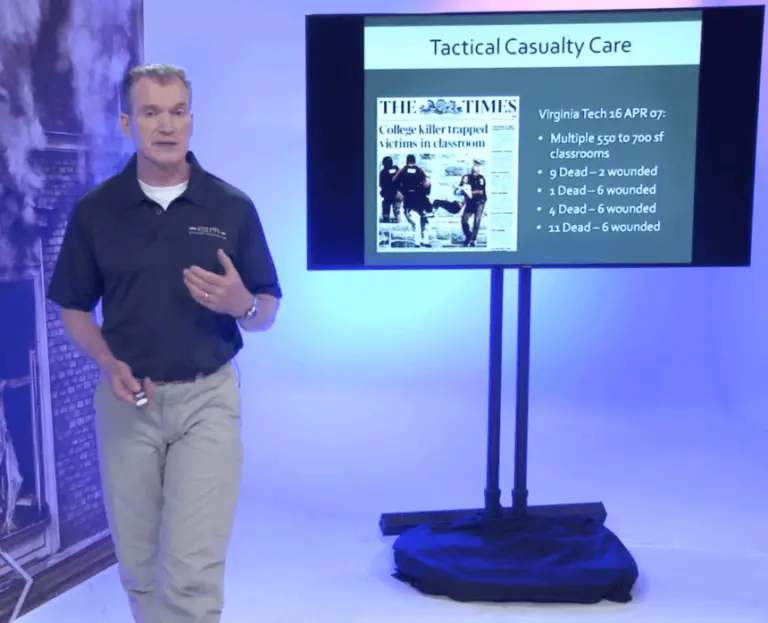
I completed the Tactical Casualty Care course both in-person and online. Being an educator at an elementary school, I think it is important to learn these tactical care techniques as we are the first line of protection for our students. The techniques can be used in any type of emergency situation earthquake, fire, and during active shooter situations. Mike is a great instructor providing information that is easy to understand, remember and replicate. I feel confident that I can help save a life!
INFORMATIVE & INTERESTING
I just finished the course! I am a teacher, working from home during COVID-19. I am a Registered Nurse and middle school Health Science teacher. In this day of school/mass shootings, this course is a valuable tool that I hope I'll never need to use.I appreciated that actual photos were used to help desensitize me to the nature of what a real life trauma may look like. In this day and age, it's so important to have these life-saving skills. I feel more confident in my ability to help should the need ever arise. The course was well organized and the information was presented in a very clear and understandable manner.
EXACTLY WHAT I NEEDED TO UNDERSTAND THE TOPIC IN AN ONLINE COURSE
No one wants to think about situations like this, especially not when you work with young children. However, it is important to me to be prepared with the hope that I'll never have to use what I learned in this course. Having no medical background myself, Dr. Shertz made this course digestible and engaging to someone like me. The pictures, while graphic, were exactly what I needed to understand the topic in an online course where you can't ask questions. His pace is perfect, and he covers all important topics with no "fluff." My free time as an educator is valuable and short, and I feel that this course was an excellent use of it. While it isn't something I necessarily want to feel comfortable about, I do feel like in an emergency, I could remain calm, remember the material, and maybe even help save a life. I highly recommend this course to anyone, but especially educators.
I WANTED THE BEST AVAILABLE, MOST REALISTIC AND COMPREHENSIVE TRAINING.
I'm a high school teacher, and now I have a fairly new responsibility of bleeding control knowledge under "other duties as assigned."I wanted the best available, most realistic and comprehensive training. After taking the course himself, as well as several others, my boyfriend decided this was the best course on the market for my additional responsibility at school. I have to agree; due to the training I received, I have successfully dealt with a 911 call, another lesser emergency, and have been able to identify and insist on the removal of 800 counterfeit tourniquets from our school classrooms.
Without the training from Crisis Medicine, I would not have been as prepared to confidently address these emergencies. I hope not to use these skills, but I know I can if my students and colleagues need.
TAKE THIS COURSE... YOU WILL NOT REGRET IT!
The information in this course would be valuable in a number of settings, but it's an absolute must for law enforcement. Having taken a ton of online courses (completed a Masters Degree online), I was really surprised at how well this course delivered. All of the content was relevant... NO fluff.Dr. Shertz was an engaging presenter, and it was clearly evident that he knows his stuff. The section on wound ballistics was the most thorough information I'd ever gotten on the subject, both as a Marine and a Sheriff's Deputy, and it put casualty care approaches in context. Speaking as a School Resource Deputy, this should be required training for anyone who knows that they have the potential for being involved in an active violent event.