An N95 mask blocks 100% of ionizing radiation alpha particles (𝜶)

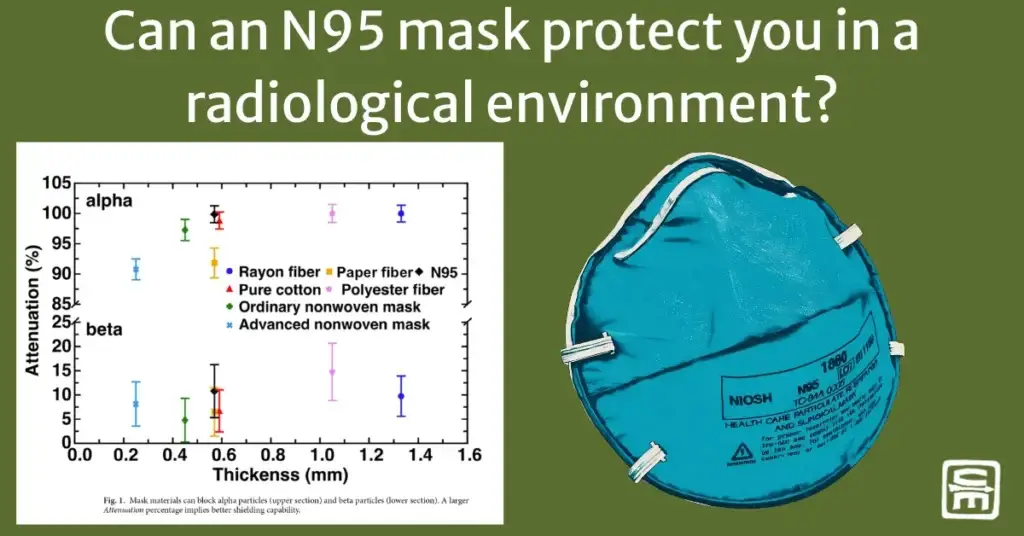
Can an N95 mask block ionizing radiation? A chart summarizing data on N95 effectiveness against Alpha and Beta particle inhalation, and a cartoonized N95 Mask

Researched and written by Mike Shertz, MD/18D, not AI

In a radiological event, the primary risk of internal contamination comes from inhaling or ingesting radioactive particles. While 𝜶 radiation cannot penetrate a uniform or intact skin, these particles cause significant cellular damage once they enter the lungs or are swallowed.

🕖 Reading Time, 3 minutes

BLUF

  • Alpha (𝜶) Particles: N95 masks provided 100% protection against Am-241, Cm-244, and Pu-239.
  • Beta (β)Particles: No tested “local chain store” mask—including N95s—significantly reduced exposure to Sr-90.
  • The Verdict: If you are forced to use improvised PPE, an N95 is your best defense against internally dangerous 𝜶-emitters, but it is not a shield against β or Gamma (𝜸) rays.

Ionizing radiation is comprised of 𝜶 and β particles, and 𝜸 rays. 𝜶 particles are blocked by less than 1/10 of a millimeter of intact skin / human tissue. However, they can cause significant radiation exposure to internal organs if ingested or inhaled. This can result in increased cancer risk at best, and death from acute radiation syndrome at worst, if the exposure is significant enough. 

β particles can penetrate through several millimeters of biological tissue on their own. 𝜸 rays require substantial shielding to block their effects.

In the event of a nuclear detonation or accident, both the National Council on Radiation Protection and Measurements, as well as the US CDC, recommend the public use face masks as protection against inhaling / ingesting radioactive material / contamination when they can’t immediately get inside. 

A Taiwanese study evaluated seven commonly available face masks bought from a “local chain store” for their ability to block 𝜶 and β particle penetration. 

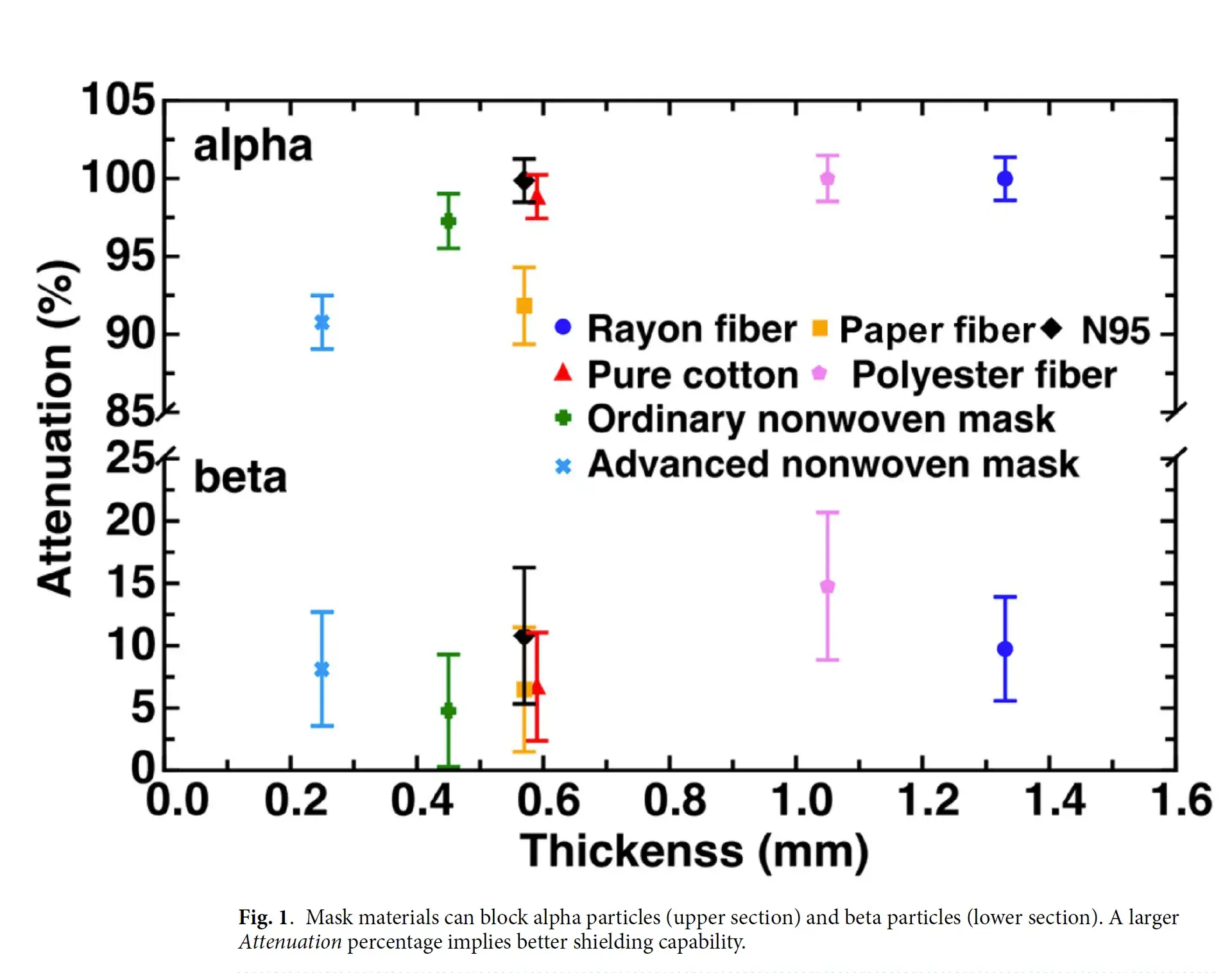
Attenuation was defined as the percentage reduction of inhaled 𝜶 and β particles through the tested mask as measured by Geiger-Mueller counter and surface barrier detector.

All tested mask materials blocked at least 90% of 𝛼 particle radiation and several mask types blocked 100%. Although a polyester fiber, rayon fiber, and N95 mask all showed 100% reduction, if you were buying a mask in a store, only the N95 would be easily identifiable / labelled as to its construction and therefore, reduction abilities. 

Unfortunately, none of the masks were effective at significantly reducing β particle exposure.

Tested 𝜶 particles included Am-241, Cm-244, and Pu-239. The β source was Sr-90.

Think this is esoteric?

Americium 241, an 𝜶-emitter, is present in household smoke detectors. In 2004, a London terror cell collected thousands of smoke detectors to harvest the radioactive material in preparation for a radiological dispersion device or “dirty bomb.”

If you are forced to use a “face mask” in an ionizing radiation exposed situation, an N95 mask is your best for protection against ingested / inhaled 𝜶 particles.

A chart summarizing data on N95 effectiveness against Alpha and Beta particle inhalation
Chart from the article by Wu, H, et al, reference as below.

References

Wu H, Liu HD, Lin TH, Lin MW. Measurements of face mask’s capability to block ionizing radiation. Sci Rep. 2025 Feb 22;15(1):6516. doi: 10.1038/s41598-025-89643-4. PMID: 39987210; PMCID: PMC11846965.

Picture of Laurie Shertz

Laurie Shertz

Laurie Shertz, JD, is a former attorney with extensive experience representing clients in Federal and State courts in the Pacific Northwest and Washington, DC. Transitioning her skills from the legal field to Crisis Medicine, Laurie serves as the Chief Logistics Officer, where she oversees contracts, grant writing, website management and development, coordinates in-person training logistics, and works as a producer and editor for our online training programs. Her meticulous organizational skills and strategic mindset support the company’s mission to enhance readiness and response for treating casualties in high-risk environments. Laurie is passionate about leveraging her expertise to provide strategic support to Crisis Medicine, while ensuring smooth operations and exceptional training experiences. Laurie maintains certification as an Oregon EMR.