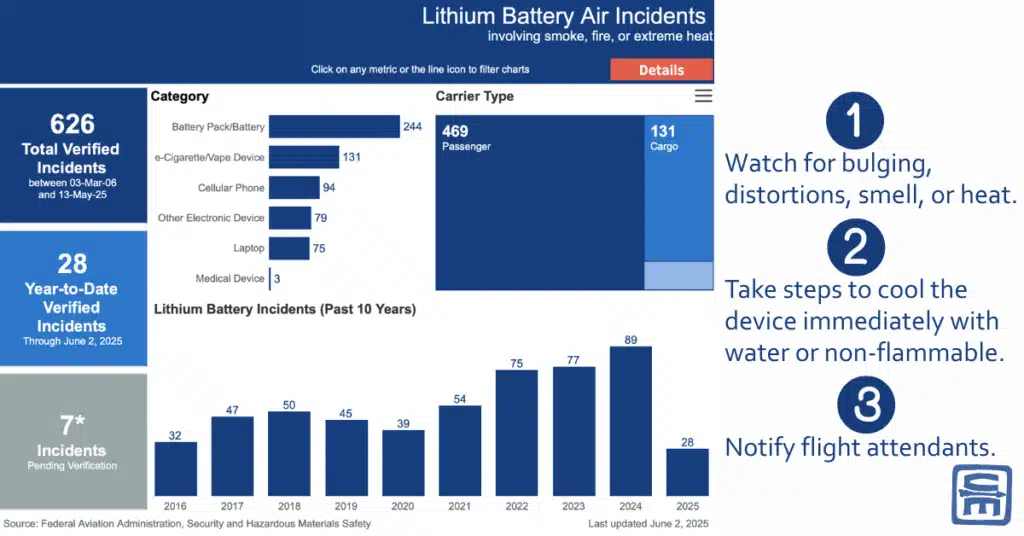
Lithium-ion batteries are ubiquitous in personal electronic devices and now causing fires.
Researched and written by Mike Shertz, MD/18D, not AI
🕖 Reading Time, 2 minutes
Since 2006, 626 events involving smoke, fire, or extreme heat in aircraft cabins from those batteries have occurred.
Fires in personal devices with lithium batteries is currently the most common cause of in-flight fires. Each year, the frequency of these events increases.
Once the batteries begin to overheat, they can go into thermal runaway, where one battery burns and ignites the neighboring battery, resulting in overheating and serial burning.
To prevent the overheating batteries from fully catching fire and to stop the sequence, they need to be immediately cooled with water or any nonflammable liquid (no, your mini-bar liquor bottle will not work for this purpose). Fully submerging the device in liquid allows the liquid to get inside the device and to the battery, thereby hopefully cooling the device.
On a plane, notify the flight attendants immediately, and they will take it from there.
An example of a chaotic evacuation after a small, controlled fire
On July 12, 2024, American Airlines flight 2045, an Airbus A-321, had an emergency evacuation at San Francisco International Airport secondary to a passenger’s smoking laptop. Lithium ion batteries in personal electronic devices are currently the most common cause of in aircraft fires.
Videos of this particular evacuation demonstrate what has been known for some time about the flying public:
- Passengers lack an appreciation for the seriousness of the event. In this evacuation, at least one passenger argued with the flight attendant about whether they needed to evacuate at all.
- They ignore crew commands.
- They often take their hand carry bags with them during the evacuation.
- They frequently try to exit through the door they boarded from, despite much closer and more convenient emergency exits being available. One air accident investigation noted 30% of passengers don’t evacuate through the closet emergency exit.
- They record the events instead of rapidly evacuating, as clearly happened here.
What does all of this mean?
Your emergency evacuation of a commercial aircraft will be hectic and chaotic enough based just on the situation. Adding unnecessary friction from the poorly behaved flying public will make it worse and in a more dangerous situation it might cause casualties. Airlines do not evacuate planes lightly: putting an airplane back in service after an emergency evacuation typically costs between $50,000 and over $100,000+ per incident, largely driven by replacing and repacking emergency slides ($12,000–$70,000+). So if you’re asked to get out, get out.